What's Behind Your Child's Angry Behavior
Anger is loud. It commands attention. But anger is rarely the whole story. Beneath your child's outburst, there is almost always another emotion doing the real work — one that is quieter, harder to name, and far more important to understand.
What You'll Learn
- Anger is often a "secondary emotion" masking deeper feelings like anxiety, sadness, shame, or sensory overload.
- Track patterns in your child's anger to uncover the true trigger, which is often not the event that immediately preceded the outburst.
- Name the emotion underneath during calm moments by reflecting what you observe, such as frustration or fear, to build emotional vocabulary.
- Respond to the root cause rather than just the surface behavior, because anger driven by anxiety needs reassurance while anger driven by shame needs acceptance.
- Stories and characters can help children identify layered emotions they cannot yet articulate about themselves.
What Is the Anger Iceberg?
The anger iceberg is a concept used by child psychologists to explain that anger is usually a “secondary emotion”—the visible part above the waterline, masking deeper primary feelings like anxiety, sadness, shame, or sensory overload beneath the surface. Understanding what drives your child's anger changes how you respond to it.
Imagine an iceberg. The part you see above the waterline is anger: the yelling, the slamming doors, the “I hate you.” But beneath the surface, invisible and far larger, are the emotions that are actually driving the behavior. Denham et al. (2003, Social Development) found that emotional competence in preschoolers—especially the ability to identify and express emotions accurately—predicts social functioning and behavioral adjustment throughout childhood.
Psychologists call anger a “secondary emotion”—meaning it often shows up in response to a deeper feeling that your child finds harder to express or sit with. Dodge et al. (2006, Developmental Psychology) demonstrated that children who seem constantly angry often struggle to read social situations accurately: they misread neutral moments as threatening and respond with aggression because their brains are interpreting the world through a lens of fear or frustration.
This reframe is one of the most important shifts a parent can make. When you stop asking “Why is my child so angry?” and start asking “What is my child feeling beneath this anger?”—everything changes.
What hides beneath anger
Anxiety
Fear of failure, uncertainty, loss of control
Sadness
Grief, loss, disappointment, loneliness
Frustration
Demands exceeding skills, feeling stuck
Shame
Feeling defective, not good enough, exposed
Sensory Overload
Too much noise, touch, visual input, transitions
Jealousy
Perceived favoritism, fear of being replaced
When Does Anxiety Wear an Angry Mask?
Anxiety and anger are more closely linked than most parents realize. When your child feels scared or uncertain, their body goes into the same fight-or-flight mode. Some children flee (avoidance, pulling away). Others fight (anger, defiance, lashing out). The feeling underneath is the same; what it looks like on the outside is different.
A child who explodes when asked to try something new may not be defiant. They may be terrified of failing. A child who screams at a sibling who touched their things may not be possessive. They may be anxious about their world being unpredictable. A child who rages before school every morning may not hate school. They may be overwhelmed by social uncertainty they cannot articulate.
Cole et al. (2004, Child Development) found that children who struggle to manage big feelings often default to anger because it feels more powerful and less vulnerable than the emotion it is covering. Anger says “back off.” Anxiety says “I am scared.” For a child who does not feel safe being vulnerable, anger is the easier choice.
How Do Sadness and Frustration Drive Angry Behavior?
In many families and cultures, sadness is harder for children to express than anger. Boys in particular often receive the message that sadness is weakness but anger is acceptable. The result is children who cry with their fists instead of their eyes.
A child who lost a friendship, is grieving a change like a move or divorce, or feels lonely at school may have no safe outlet for that sadness. So it comes out sideways—as irritability, short temper, and seemingly unprovoked anger. If your child's anger seems to have no clear trigger, sadness is one of the first emotions worth exploring.
Frustration is another common driver, especially for children whose abilities do not yet match their ambitions. A child who cannot tie their shoes, finish a puzzle, or read as fast as their classmates may express that gap as rage. This is particularly common in children with learning differences, ADHD, or developmental delays—the daily experience of things being harder for them than for peers is genuinely frustrating, and that frustration accumulates (Bariola et al., 2011, Child Development Perspectives).
How Does Shame Fuel Anger in Children?
Of all the emotions that hide beneath anger, shame may be the most destructive and the hardest to spot. Shame is not “I did something bad.” Shame is “I am bad.” And that distinction matters enormously.
A child experiencing shame may lash out the moment they make a mistake—tearing up their homework, throwing the game board, screaming that the teacher is stupid. These reactions look like defiance or aggression. But the actual sequence is: mistake happens, shame floods in (“I am stupid, I am broken, something is wrong with me”), and anger erupts as a defense against that unbearable feeling.
Sukhodolsky et al. (2016, Journal of the American Academy of Child & Adolescent Psychiatry) found that effective approaches to childhood anger need to address these deeply held beliefs—the stories your child tells themselves about who they are and what the world thinks of them that make anger feel necessary. Punishing the anger without addressing the shame often makes both worse.
When Does Sensory Overload Drive Angry Outbursts?
Not all anger begins with an emotion. Sometimes it begins in the body. Children with sensory processing differences may experience ordinary environments—a noisy cafeteria, scratchy clothing, flickering fluorescent lights—as genuinely painful or overwhelming. Their anger is not about feelings. It is about survival: their nervous system is screaming that something is wrong.
Even children without a sensory processing diagnosis can be pushed to anger by physical states: hunger, fatigue, illness, or simply a day with too many transitions. Eisenberg et al. (2001, Psychological Bulletin) demonstrated that a child's ability to stay focused and manage their behavior is significantly worn down by physical stressors, making anger outbursts more likely when their body's resources are running low. The child who melts down at 5pm every day may not have an emotional problem. They may have a scheduling problem—too much activity, not enough rest, and a body that has used up all its resources.
If your child's anger tends to follow predictable physical patterns (time of day, certain environments, after specific activities), pay attention. The solution may be environmental before it is emotional.
How Can Parents Look Beneath the Surface of Anger?
Becoming a detective for your child's hidden emotions is a skill, and it gets easier with practice. Here are approaches that help.
Track the patterns
Keep a simple log for one to two weeks. When does the anger happen? What preceded it (not just the immediate trigger, but the whole day)? What happened after? Patterns will emerge that reveal the true source. A child who rages every evening after school is telling you something about their school experience.
Name the underneath emotion
During a calm moment (never during the outburst), try reflecting what you see: “You seemed really angry when you could not finish that puzzle. I wonder if underneath the anger, you were feeling frustrated that it was so hard.” You may not always be right, but you are teaching your child that emotions have layers—and that it is safe to explore them.
Respond to the need, not just the behavior
If a child's anger is driven by anxiety, they need reassurance and coping tools. If it is driven by frustration, they need scaffolding and adjusted expectations. If it is driven by shame, they need unconditional acceptance. The behavior (anger) may look the same, but the response should be tailored to the root cause. For practical de-escalation approaches, see our guide on calming strategies that actually work.
Use stories to build emotional vocabulary
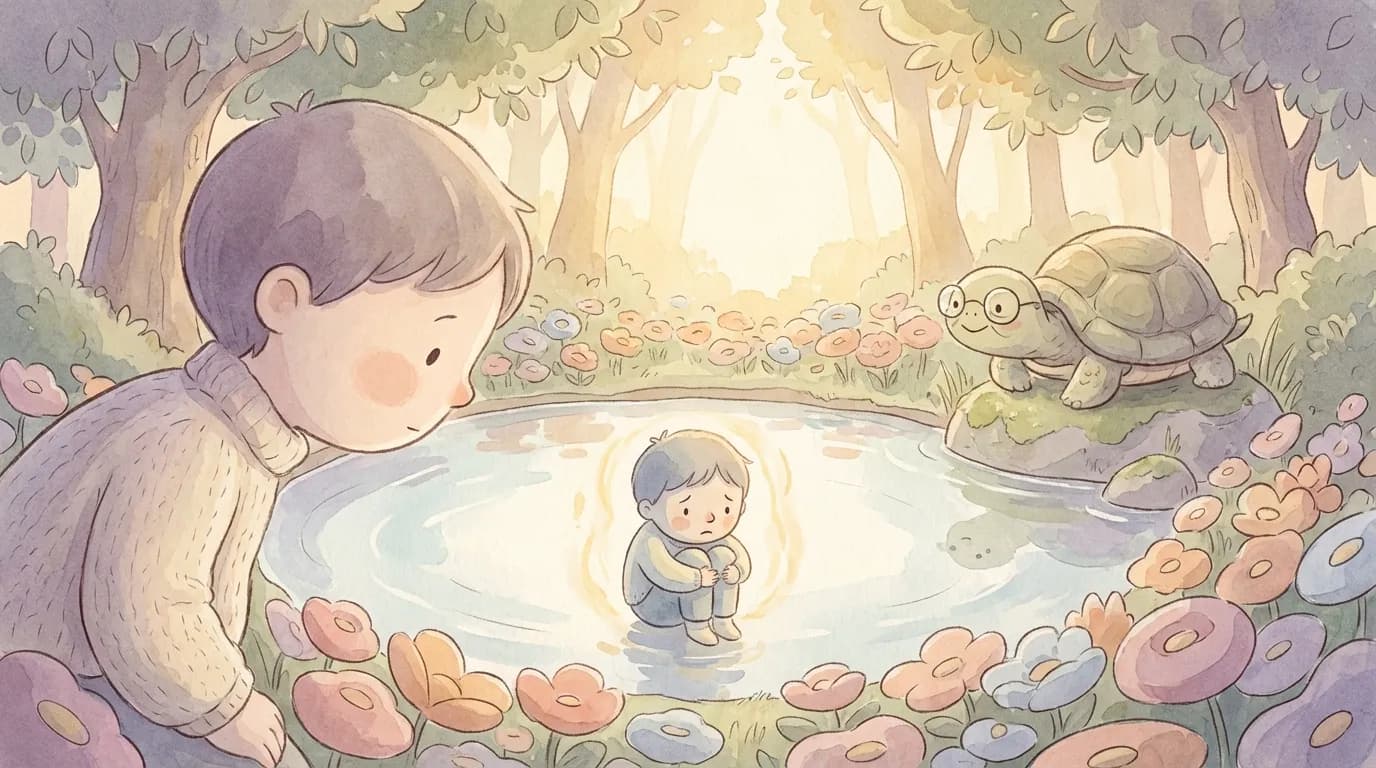
Children who struggle to identify their own emotions can often identify emotions in characters. When a story character feels angry because they are actually scared or sad, it gives your child language for their own experience. This is the principle behind personalized storytelling for anger—and it is one of the reasons stories can reach children where direct conversation cannot.
What Should Parents Avoid When Responding to Anger?
Understanding the anger iceberg also means understanding which common parenting responses can backfire.
- Do not punish the anger itself. If anger is a signal that something deeper is wrong, punishing the signal teaches your child to suppress it—not to resolve the underlying issue. The anger goes underground, but the pain stays.
- Do not demand “calm down.” A child in the grip of overwhelming feelings cannot calm down on command any more than you can stop being anxious because someone tells you to relax. Telling a child to calm down when their emotions have taken over just adds shame to the pile.
- Do not interrogate during the episode. “Why are you so angry?” asked during an outburst produces nothing useful. Your child genuinely cannot access that information in the moment. Save the conversation for later.
- Do not take it personally. “I hate you” from an angry child is not a factual statement about your relationship. It is an overwhelmed child reaching for the most powerful words they have. Let it pass.
Frequently Asked Questions
Common questions parents ask.
Stories That Reach What Words Cannot
HeroMe creates personalized stories that help your child explore the emotions beneath their anger—through characters they love, in a world they recognize. No lectures. Just stories that help them understand themselves.
Start Your Free Story