The Comparison Trap: Helping Your Child Value Themselves
'She's prettier than me.' 'He's better at everything.' 'Everyone else has more friends.' If your child has started measuring their worth by how they stack up against others, they have fallen into one of childhood's most common and most painful traps.
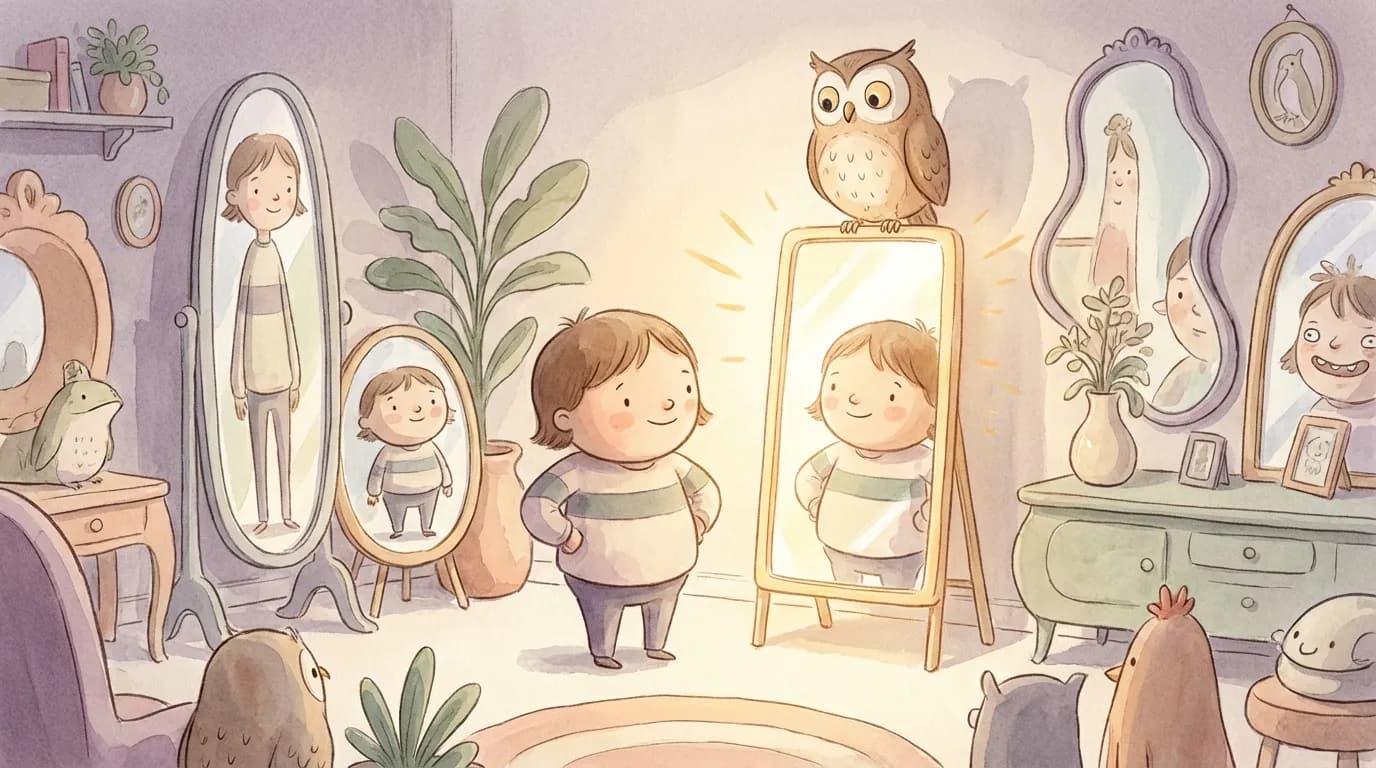
What You'll Learn
- Social comparison is a hardwired human behavior that intensifies around age six, not a character flaw your child needs to overcome.
- When your child says "she's better than me," validate their observation first, then help separate admiration from inadequacy.
- Replace social comparison with temporal comparison: measure your child's growth against their own past self, not against peers.
- Broaden your child's definition of "strengths" beyond academics and athletics to include kindness, humor, persistence, and curiosity.
- Building intrinsic motivation — driven by genuine interest rather than ranking — is the long-term antidote to the comparison trap.
Why Do Children Compare Themselves to Others?
Social comparison is a hardwired human behavior, not a character flaw. Psychologist Leon Festinger demonstrated that people naturally evaluate themselves by comparing to others—especially when objective standards are absent, which describes most of childhood. Understanding this helps parents respond to “she’s better than me” with empathy rather than frustration.
Social comparison is not a character flaw. It is a hardwired human behavior. In 1954, psychologist Leon Festinger published his social comparison theory in Human Relations (DOI: 10.1177/001872675400700202), demonstrating that people naturally evaluate their abilities and opinions by comparing themselves to others. This is especially true when objective standards are absent—which describes most of childhood. How fast should a seven-year-old read? How many friends is “enough”? Without clear benchmarks, children look sideways.
The tendency intensifies around age six or seven, when children enter school and are suddenly surrounded by peers performing the same tasks. They notice who gets called on, who gets praised, who gets picked first for teams. By age nine or ten, social comparison becomes a primary lens through which children evaluate their own worth.
Some comparison is healthy. It helps children set goals and understand social norms. The problem arises when comparison becomes the only source of self-evaluation—when your child cannot feel good about themselves unless they are “better” than someone else, or when they feel worthless because someone else seems to have more. That worthlessness can spiral into negative self-talk that is hard to shake.
What Are the Two Directions of Social Comparison?
Not all comparison is the same. Understanding the two directions helps you respond more effectively when your child is caught in the trap.
“She’s better than me”
The child looks at someone who has more, does better, or seems happier. In small doses, this can inspire. But when it becomes habitual, it leads to feelings of inadequacy and the belief that they will never measure up. Children stuck in upward comparison often stop trying because the gap feels too large.
“At least I’m better than him”
The child looks at someone who has less or does worse to feel better about themselves. While this might provide temporary relief, it builds self-worth on a fragile foundation. It also erodes empathy and can lead to unkindness toward others. Neither direction produces stable, genuine self-esteem.
The alternative to both is what psychologists call “temporal comparison”—comparing yourself to your past self rather than to other people. “Look how much better you are at this than you were last month.” This is where growth mindset research by Dweck (2006, Mindset: The New Psychology of Success) intersects with self-esteem. When children measure progress against their own baseline, they develop motivation that no one else can take away. For more on this approach, see our guide on building genuine confidence.
How Does Social Media Amplify the Comparison Trap?
For children under eight, the comparison trap is mostly fed by in-person interactions at school and in activities. But for older children, social media acts as an accelerant. It takes the natural human tendency to compare and supercharges it with curated, filtered, endlessly scrollable content.
Baumeister and colleagues (2003, Psychological Science in the Public Interest; DOI: 10.1111/1529-1006.01431) noted that self-esteem is most vulnerable when people feel they are being evaluated. Social media creates a perpetual evaluation environment: likes, followers, comments, and the carefully posed images that make everyone else’s life look effortless. For a child whose sense of self is still forming, this is corrosive.
If your older child uses social media, this does not mean you need to ban it entirely. But it means having ongoing, honest conversations about the gap between curated content and real life. It means helping them notice how they feel after scrolling. And it means ensuring that their primary sources of self-worth come from the real world—from relationships, effort, and experiences—not from a screen.
How Should You Respond When Your Child Says “She’s Better Than Me”?
When your child says “She is better than me at everything,” your instinct might be to disagree or to list all the things your child excels at. But neither response reaches the real need. Here is what does.
Validate, do not argue
“It sounds like you really admire something about her. That makes sense; she is good at that.” By acknowledging what your child sees, you signal that their perception matters and that you are not going to gaslight their experience. This builds trust. It also gently challenges the all-or-nothing thinking (“she is better at everything”) by focusing on something specific.
Separate admiration from inadequacy
“Admiring someone is a wonderful thing. It means you notice what is good in the world. But admiring someone is different from feeling less than them. Do you see the difference?” This teaches a sophisticated emotional skill: you can appreciate someone else’s strengths without diminishing your own. Neff (2011, Self-Compassion) calls this “common humanity”—the recognition that everyone has strengths and everyone struggles.
Redirect to their own story
“What about you? What are the things that make you, you?” Help your child name their own strengths—not in competition with anyone else, but as a reflection of who they are. Strengths are not just academic or athletic. Kindness is a strength. Humor is a strength. Being a loyal friend, being curious, being creative, being brave enough to keep trying when something is hard—all strengths.
How Do You Build Intrinsic Motivation as an Antidote to Comparison?
The comparison trap is fundamentally a problem of external validation. The child has learned that their worth depends on how they measure up. The long-term solution is to help them develop intrinsic motivation—the internal drive that comes from interest, curiosity, and personal meaning rather than from ranking or approval.
Research by Marsh and Craven (2006, Perspectives on Psychological Science; DOI: 10.1111/j.1745-6916.2006.00010.x) demonstrates that how children see themselves and what they achieve feed each other. When children feel capable in a domain that matters to them, they invest more effort, which produces growth, which strengthens how they see themselves. But this cycle only works when the motivation is internal. External comparison short-circuits it by tying your child’s self-image to someone else’s performance.
Practical ways to build intrinsic motivation
- Follow their curiosity. When your child shows genuine interest in something—bugs, drawing, building, cooking—support it without turning it into a competition or performance.
- Emphasize the process. “What was the most interesting part?” rather than “Did you win?” or “What grade did you get?”
- Measure growth against self. “Remember when you could not do a single cartwheel? Look at you now.” Temporal comparison is the healthy alternative to social comparison.
- Avoid comparative praise. “You are the best reader in your class” teaches the child that being best is what matters. “You are reading books that challenge you” teaches them that growth is what matters.
- Let them see you fail. Share your own moments of comparison and how you move past them. “I saw my colleague’s presentation and felt like mine was not as good. Then I reminded myself that we have different strengths.”
How Can You Help Your Child Find Their Unique Strengths?
Children caught in the comparison trap often have a narrow definition of what counts as a “strength.” They think strengths mean being the smartest, the fastest, or the most popular. Broadening their definition is one of the most helpful things you can do.
Harter’s research (2012, The Construction of the Self) shows that children’s self-esteem is most influenced by their perceived competence in domains they value. This means the path to healthy self-esteem is two-fold: help your child discover what they genuinely value (not what peers or culture says they should value) and then help them build competence in those areas.
Strength-spotting: a practice for parents
Over the next week, watch your child in their natural habitat. Notice what they gravitate toward without being asked. Then name what you see.
- Character strengths: “You always check on your sister when she is upset. That empathy is a real gift.”
- Process strengths: “You did not give up on that LEGO set even when the instructions were confusing. That persistence will serve you your whole life.”
- Interest strengths: “The way you notice every bird at the park—you have a scientist’s eye for detail.”
- Social strengths: “Your friends always want you on their team because you make everyone laugh and feel included.”
How Do Stories Show Children Their Worth?
There is a reason so many children’s stories feature protagonists who feel different, out of place, or “less than”—and then discover that their uniqueness is exactly what makes them the hero. These narratives are not just entertaining. They are doing emotional work.
Brummelman and colleagues (2015, Proceedings of the National Academy of Sciences; DOI: 10.1073/pnas.1420870112) found that children who receive warmth (rather than overvaluation) develop healthier self-esteem. Stories provide a form of warmth: they say to the child, “You are seen. Your struggles are real. And you are worthy of a story.” This is different from “You are the most special child in the world,” which inflates. It is grounding. It is honest.
Personalized storytelling takes this further by personalizing the narrative. When the protagonist shares your child’s name, their favorite stuffed animal, and their specific struggle with feeling “less than,” the story becomes a mirror. The child watches a version of themselves face the comparison trap and find solid ground—not by being the best, but by discovering what makes them irreplaceable. To learn more about how stories function as research-informed tools, see our guide to bibliotherapy.
Frequently Asked Questions
Common questions parents ask.
A Story Where Your Child Is the Hero—Not Because They’re “The Best,” But Because They’re Themselves
Create a personalized story that shows your child what makes them irreplaceable—not by comparing them to anyone else, but by reflecting their unique strengths back to them. Built on research. Designed for bedtime.
Start Your Free Story