Sibling Rivalry Ages 3-5: When Sharing Feels Impossible
Your preschooler snatches a toy, shoves a sibling, and screams "Mine!" before you can finish a sentence. Or maybe a new baby has arrived and your once-easygoing three-year-old is suddenly having accidents, refusing to sleep alone, and asking why the baby cannot "go back." This is not a discipline failure. It is a small child trying to make sense of the most disorienting experience of their young life: having to share the people they love most.
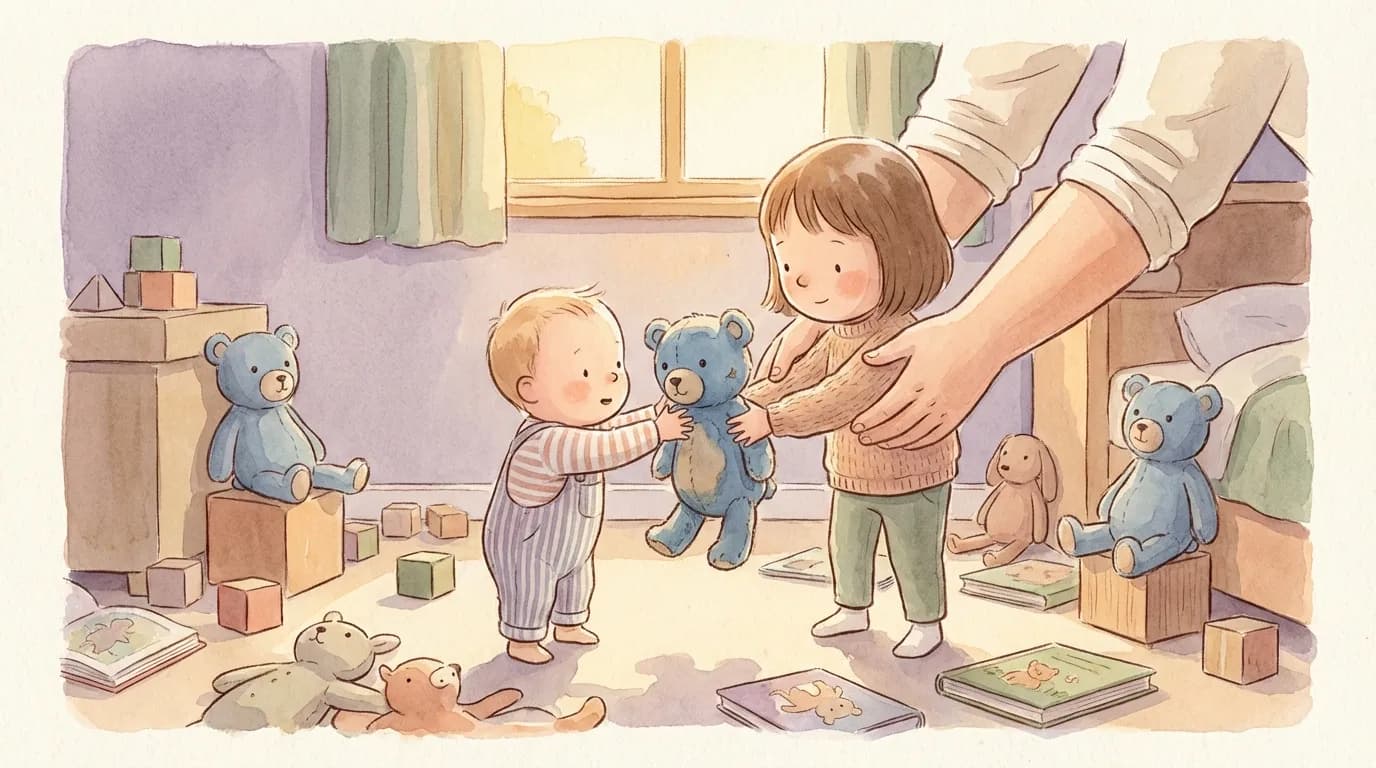
What You'll Learn
- Preschoolers who act out after a new sibling arrives are processing an existential shift, not misbehaving.
- Use turn-taking instead of forced sharing to build genuine generosity over time.
- Prevent physical conflicts by staying close, intervening calmly, and coaching replacement words for hitting.
- Give your older child a daily ritual of undivided attention, even fifteen minutes, to counter feelings of being replaced.
- Shared play and personalized stories help siblings bond from a place of security rather than competition.
How Does Sibling Rivalry Affect Children Ages 3–5?
Sibling rivalry in children ages 3–5 often centers on new sibling adjustment, sharing difficulty, and physical conflicts like hitting, pushing, and grabbing. Preschoolers who feel replaced by a baby may regress to earlier behaviors. Understanding that sharing is genuinely difficult at this developmental stage—not a character flaw—helps parents respond with empathy rather than frustration.
When a new baby enters the family, your preschooler's world tilts on its axis. The person who was the center of everything—you—is now absorbed by a tiny stranger who cries, eats, and sleeps around the clock. For a child between three and five, this is not a minor adjustment. It is an existential crisis. They do not yet have the cognitive tools to understand that love is not a finite resource, so every moment of attention given to the baby feels like attention stolen from them.
Volling (2012, Psychological Bulletin, DOI: 10.1037/a0026921) found that the transition to siblinghood is one of the most significant psychological events in early childhood. Firstborn children commonly show increased anxiety, regression in toileting or sleep, clinginess, and oppositional behavior in the weeks and months following a sibling's birth. These are not signs of failure. They are signs of a child processing a massive life change with a brain that cannot yet put feelings into words.
The regression you see—the baby talk, the thumb-sucking, the wet beds—is your child's way of saying, “If being small and helpless gets attention, maybe I should be small and helpless too.” It is not manipulation. It is survival logic, filtered through a three-year-old's understanding of the world.
Why Sharing Is So Hard at This Age
If your preschooler treats every toy as a hill to die on, it is not because they are selfish. It is because at this age, their world truly revolves around themselves—what psychologist Jean Piaget described as a stage where children genuinely cannot take another person's perspective. Your three-year-old does not understand that their sibling also wants the red truck. They understand that they want the red truck, and that is the entirety of their world in that moment.
Brownell et al. (2012, Infancy, DOI: 10.1111/j.1532-7078.2012.00125.x) found that kindness and helping behavior is already emerging in toddlers, and that parents' talk about emotions plays a significant role in supporting its development. However, sharing and helping at this age remain inconsistent and heavily dependent on context. Forcing a three-year-old to share before this capacity is more firmly established does not teach generosity. It teaches them that their possessions are not safe and that adults will override their wishes without warning.
This does not mean you should give up on sharing. It means you should set realistic expectations. Turn-taking (“You can use it for five minutes, then it is your brother's turn”) is more developmentally appropriate than instant sharing. Designating some toys as “mine only” and others as “family toys” gives your child a sense of ownership that actually makes them more willing to share over time, not less.
Physical Conflicts: Hitting, Pushing, and Grabbing
When siblings between three and five collide, it often gets physical. A shove over a toy. A hair-pull over who sits next to Mom. A bite when a sibling touches something forbidden. These moments are alarming, but they are also predictable—preschoolers simply do not have the language skills or impulse control to resolve conflict verbally. Their bodies act before their words can catch up.
Ostrov et al. (2006, Journal of Applied Developmental Psychology, DOI: 10.1016/j.appdev.2006.02.005) found that social aggression—such as exclusion, manipulation, and refusing to let a sibling join play—is already present in preschool-aged sibling relationships, not just physical forms of conflict. Physical aggression among young siblings is also extremely common, with the majority of conflicts lasting under thirty seconds. Children whose parents intervene with coaching—naming the problem, offering language, suggesting alternatives—tend to show faster declines in aggressive behavior than those whose parents either punish or ignore it.
What physical conflict looks like at ages 3–5
- Grabbing and snatching toys from a sibling's hands without warning or negotiation
- Hitting, pushing, or biting when frustrated during play or when a sibling encroaches on their space
- Screaming or crying as a first response to any sibling interaction that does not go their way
- Roughness with a baby sibling—squeezing too hard, “patting” that is closer to hitting, sitting on or crowding the baby
When a Preschooler Feels Replaced by the Baby
There is a particular kind of heartbreak in watching your child feel displaced. They may not say it directly, but the signs are unmistakable: they ask you to “put the baby back,” they refuse to look at the baby, they demand to be carried or fed like a baby themselves. Underneath all of these behaviors is a single, terrifying question: Do you still love me as much?
Research on the transition to siblinghood has found that the quality of the parent-firstborn relationship after a new sibling's arrival is the single strongest predictor of how the older child adjusts. Children who maintained warm, predictable one-on-one time with each parent showed fewer behavioral problems, less aggression toward the baby, and faster emotional recovery from the transition.
The antidote to feeling replaced is not reassurance alone—words only go so far with a three-year-old. It is consistent, tangible evidence that they still matter. A special routine that belongs only to them. A job that makes them feel important: “Can you help me pick out the baby's clothes? You are so good at choosing.” A nightly ritual where they have your undivided attention, even for fifteen minutes. These are not luxuries. They are the scaffolding your child needs to build a relationship with their sibling from a place of security rather than scarcity.
Create “big kid” privileges
Instead of emphasizing what your preschooler must give up or share, highlight what they get to do because they are older. Staying up a little later, choosing the bedtime story, having a special snack. This reframes being older as an advantage rather than a loss, and helps your child see their position in the family as something to take pride in.
Narrate the baby's admiration
When the baby looks toward your preschooler, narrate it: “Look, the baby is watching you! She thinks you are so interesting.” When the baby smiles in their direction: “The baby just smiled at you. I think you are her favorite person.” You are building a narrative of connection that your preschooler cannot construct on their own.
Building Sibling Connection Through Play
Preschoolers do not bond through conversation. They bond through play. And the most powerful thing you can do to strengthen the sibling relationship at this age is to create opportunities for shared play that feel safe, structured, and fun for both children—even when the age gap makes that challenging.
Howe and Recchia (2014, Early Education and Development, DOI: 10.1080/10409289.2014.857562) found that sibling play in early childhood serves as a natural laboratory for social-emotional learning. Through play, preschoolers practice negotiation, turn-taking, perspective-taking, and conflict resolution in a context that feels low-stakes. The children who engaged in the most positive sibling play showed better social skills with peers as well—suggesting that the sibling relationship is a training ground for all future relationships.
Facilitate parallel play first
If cooperative play feels too hard, start with parallel play—siblings doing the same activity side by side without needing to interact directly. Drawing at the same table. Building separate block towers in the same room. This builds comfort with proximity before requiring collaboration.
Give the older child the “teacher” role
Preschoolers love being the expert. Ask them to “show” their younger sibling how to stack blocks, how to do a puzzle, how to make an animal sound. This puts the older child in a position of competence and generosity rather than competition, and it creates a positive dynamic that carries beyond the play session.
How Stories Help Children Feel Special Even When Sharing Attention
A preschooler who feels displaced by a sibling needs something very specific: proof that they are still the hero of their own story. When a child hears a tale about a character who shares their name, their favorite stuffed animal, and their exact situation—a new baby in the house, a sibling who takes their toys—something powerful happens. They feel seen. They feel understood. And they absorb, through the safety of narrative, that this hard thing they are going through has a path forward.
This is the principle behind bibliotherapy, and it is particularly effective so effective for sibling relationships at this stage. At this age, children learn through stories far more readily than through direct instruction. A character who learns to be a “big helper” with the baby provides a model your child can internalize. A character who feels jealous and then discovers that love is not a pie—there is always enough—plants a seed that no amount of parental reassurance alone can match.
Frequently Asked Questions
Common questions parents ask.
A Story Where Your Child Is Always the Hero
Create a personalized story where your preschooler's favorite comfort objects come to life and help them discover that love does not run out—even when it is shared.
Start Your Free Story