Daily Routines for Children Ages 6-8: Building Independence
Your child has entered the world of school, homework, friendships, and responsibilities — and suddenly the routines that worked when they were four no longer fit. If after-school meltdowns, homework battles, and screen time arguments have become daily events, you are in the middle of one of the most significant routine transitions in childhood. The goal is no longer just structure. It is building the scaffolding your child needs to start managing their own day.
What You'll Learn
- After-school meltdowns are "restraint collapse" — your child held it together all day and home is safe enough to let go.
- Protect the first 20 minutes after school as a no-questions, low-demand decompression zone with a snack and quiet time.
- Schedule homework after a break and movement, not right after school, and keep it under the 10-minute-per-grade-level guideline.
- Co-create screen time rules and use external timers so the boundary feels impersonal rather than a daily parent-vs-child battle.
- Age-appropriate chores build self-regulation and a sense of belonging that transfers to better academic and social outcomes.
What Do Effective Daily Routines Look Like for Children Ages 6–8?
Children ages 6–8 face new routine challenges as school introduces homework, after-school activities, and screen time boundaries. The after-school transition home, morning chaos, and building age-appropriate chore responsibilities are the areas where structured routines make the biggest difference in reducing daily battles and building independence.
The hours between school pickup and dinner are, for many families, the hardest part of the day. Your child walks through the door and something shifts. The child who was reportedly “fine” at school is suddenly irritable, defiant, or in tears. This pattern is so common that researchers have named it: after-school restraint collapse.
Brock and Curby's research on self-regulation in school-age children demonstrated that the cognitive and emotional effort required to maintain “school behavior” all day creates a measurable depletion of self-control energy by afternoon. Children who showed the strongest self-control at school were often the ones who showed the most meltdowns at home—not because home was problematic, but because it was safe enough to finally let go. Research on self-regulation in school settings consistently shows that maintaining behavioral control throughout the school day depletes children's emotional resources, making the transition home particularly challenging.
Building a decompression routine
- The first 20 minutes are sacred: No questions about the day, no homework, no chores. Offer a snack and quiet time. Let your child's nervous system recalibrate.
- Physical movement before mental work: 15 to 20 minutes of outdoor play, jumping, or even just running around the house helps discharge the physical energy that built up during a sedentary school day.
- Same sequence daily: Snack, play, homework, free time. When the after-school flow is predictable, children can anticipate what comes next and manage their energy accordingly.
Homework Time: Building Independence Without Battles
Homework conflicts in the 6–8 age range are rarely about the homework itself. They are about a child who has already spent a full day doing cognitive work being asked to do more, often at the exact time when their brain is least equipped for it. The brain-management skills required for homework—planning, sustained attention, holding information in mind, getting started on a task—are among the last abilities to fully develop, and they are particularly fragile when a child is tired.
Cooper's meta-analysis of homework research found that for elementary-age children, the academic benefit of homework is minimal compared to the potential cost when it creates nightly family conflict. The real value of homework at this age is not academic mastery but building the habit of independent work—and that habit is destroyed if homework becomes a battleground (Cooper et al., 2006, Review of Educational Research, DOI: 10.3102/00346543076001001).
Setting up for success
- Same time every day—after decompression, never immediately after school
- A designated workspace with minimal distractions and all materials ready
- Break large tasks into small chunks with brief movement breaks in between
- Use a timer so your child can see how much time is left (makes it feel finite)
Your role as a parent
- Be nearby but not hovering—available for questions, not doing the work
- Help them start (task initiation is the hardest part) then step back
- Praise effort and persistence, not accuracy or speed
- If homework consistently takes more than 30 minutes, talk to the teacher
Screen Time Boundaries Without Daily Battles
Screen time is perhaps the most emotionally charged routine issue for families with school-age children. The reason is simple: screens are engineered to be maximally engaging, and asking a child to disengage from something designed by teams of behavioral psychologists to hold attention is genuinely difficult. This is not a willpower failure. It is a mismatch between a child's developing self-regulation and technology designed to override it.
The American Academy of Pediatrics recommends creating a “family media plan” rather than imposing rigid time limits, emphasizing that the quality of screen content and the context of use matter more than raw minutes (AAP Council on Communications and Media, 2016, Pediatrics, DOI: 10.1542/peds.2016-2592). A child watching a documentary with a parent and discussing it is a fundamentally different activity than a child passively scrolling YouTube alone.
Making boundaries work
- Make rules visible and co-created: Sit down together and decide screen time rules. Write them on a poster. When the rule is “ours” rather than “yours,” compliance increases.
- Use external timers: A visual timer or device-level time limit makes the boundary impersonal. “The timer says time is up” is easier to accept than “I say time is up.”
- Pair the end of screens with something desirable: Transition away from screens toward something, not just away from something. “When screens are done, we read our chapter together” is easier than “Screens are done, go find something to do.”
Morning Chaos and Getting Out the Door
Morning routines for 6–8 year olds are different from preschool mornings in an important way: your child is now cognitively capable of managing a multi-step routine independently—but they need scaffolding to get there. The mistake many parents make is either doing everything for the child (because it is faster) or expecting full independence (because they are “old enough”). The sweet spot is structured autonomy.
Hofferth and Sandberg's analysis of how American children spend their time found that time allocated to different daily activities—including structured routines and self-care—was associated with developmental outcomes, suggesting that the morning routine is not just about getting out the door but is actually a daily opportunity to build organizational habits (Hofferth & Sandberg, 2001, Journal of Marriage and Family, DOI: 10.1111/j.1741-3737.2001.00295.x).
Building morning independence
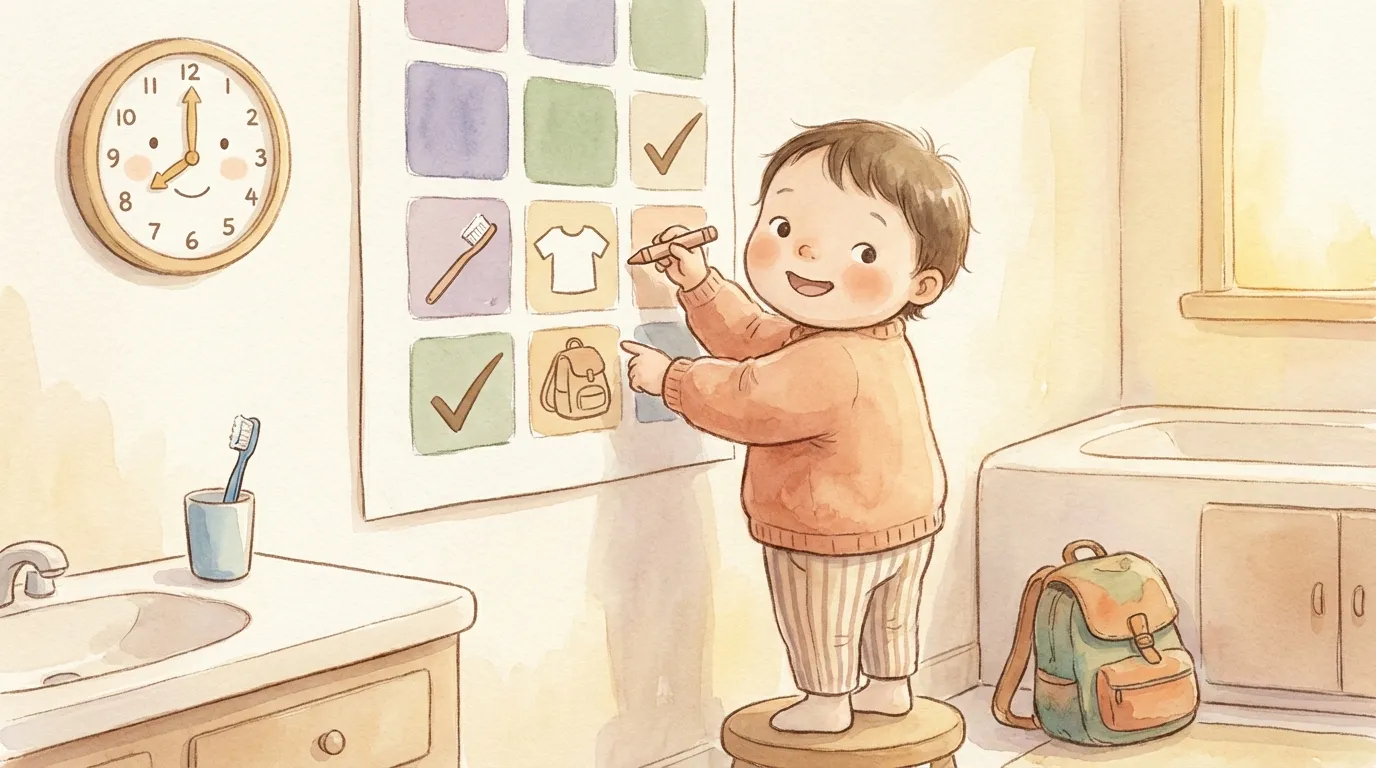
- Create a checklist your child can follow independently—with checkboxes they physically mark off
- Lay out clothes and pack bags the night before (make this part of the bedtime routine)
- Use a visible clock and teach them to self-monitor: “By the time the big hand is on the 6, you should be dressed”
- Resist the urge to rescue—natural consequences (arriving at school with messy hair) teach more than nagging
When mornings derail
- Check bedtime first—90% of morning chaos is actually a sleep problem
- Reduce morning decisions: fewer clothing choices, same breakfast rotation
- Move the wake-up time 10 minutes earlier rather than adding more rushing
- Reconnect the night before if mornings have become a conflict pattern
Chores and Responsibility at This Age
Between ages six and eight, children develop a growing capacity for responsibility—and a growing desire to feel competent and useful. Chores, when introduced well, meet both needs. The research is remarkably consistent: children who participate in household tasks develop stronger self-regulation, better academic habits, and a stronger belief in their own ability to handle things.
Rende's research found that participation in household routines during elementary school years was one of the strongest predictors of academic success and social competence in adolescence—stronger than IQ or socioeconomic status. The mechanism appears to be that regular contribution to the household builds a sense of belonging and competence that transfers to other domains (Rende, 2015, The Brown University Child and Adolescent Behavior Letter, DOI: 10.1002/cbl.30009).
Making chores work
- Start small and build: One consistent chore done daily is better than a rotating list that feels overwhelming. Add new tasks only after the current ones are habitual.
- Teach the task explicitly: Do it together several times before expecting independent completion. What seems obvious to you is brand new to them.
- Accept imperfection: A bed made with lumpy covers is a successfully completed chore. Redoing it teaches your child that their effort does not matter. Lower the bar and celebrate the attempt.
How Stories Reinforce Routine Habits Through Characters
At ages six to eight, children are moving beyond the pure imaginative play of the preschool years into what developmental psychologists call the “age of industry.” They care deeply about competence, mastery, and how they compare to peers. Stories that feature characters their age working through daily routines—getting ready for school, tackling homework, negotiating screen time—provide a powerful form of social modeling.
Bandura's social learning theory demonstrated that children learn behaviors most effectively through observing models they identify with. When a story character who shares your child's name, age, and daily challenges figures out how to manage their morning routine or push through a frustrating homework problem, your child is not just hearing a story—they are watching a peer succeed. Bandura's social learning framework, developed across decades of research, shows that observational learning from relatable models is one of the most powerful drivers of behavior change in children.
Frequently Asked Questions
Common questions parents ask.
Daily Routines at Other Ages
Routine challenges evolve as your child grows. Explore what to expect at every stage.
A Story That Builds Your Child's Daily Confidence
Create a personalized story where your child's character tackles after-school routines, homework challenges, and daily responsibilities with growing independence. Designed for children ages 6 to 8.
Start Your Free Story