Daily Routines for Children Ages 3-5: Adventures Not Chores
Your preschooler lives in a world that feels enormous, unpredictable, and sometimes overwhelming. Routines are not about control — they are about creating a map through the day that your child can actually follow. If mornings end in tears, mealtimes become battlegrounds, and transitions trigger meltdowns, you are not failing. You are parenting a child whose brain is not yet wired for the kind of flexibility adults take for granted.
What You'll Learn
- Predictable daily routines give preschoolers emotional security by removing the anxiety of not knowing what comes next.
- Use visual routine charts and give one instruction at a time, since the preschool brain can only hold one step at once.
- Ease transitions with two-minute warnings, visual timers, and transition rituals like a specific song or countdown.
- Follow the Division of Responsibility at meals: you decide what, when, and where; your child decides whether and how much to eat.
- When routines are framed as stories and adventures rather than rules, preschoolers internalize them willingly through narrative rehearsal.
Why Are Daily Routines So Important for Children Ages 3–5?
For children ages 3–5, predictable routines provide emotional security in a world that often feels unpredictable. Transitions are the hardest part of a preschooler's day, and morning routines, mealtime structures, and bedtime rituals reduce meltdowns by removing the anxiety of “what comes next?” Consistency matters more than perfection.
Between ages three and five, children are building their internal model of how the world works. They do not yet have the mental wiring to hold flexible plans in their mind, adjust expectations on the fly, or tolerate ambiguity about what comes next. When a preschooler knows what happens after breakfast, and after that, and after that, their nervous system can relax. The world feels predictable. And predictability, for a young child, is safety.
This is not a parenting philosophy—it is neuroscience. Research by Spagnola and Fiese found that predictable family routines were one of the strongest protective factors for emotional regulation in preschool-aged children, buffering against the effects of stress, family disruption, and even poverty (Spagnola & Fiese, 2007, Infants & Young Children, DOI: 10.1097/01.iyc.0000290352.32170.5a). The children who had consistent daily rhythms showed fewer behavioral problems and better emotional coping—not because their lives were easier, but because their days were predictable.
When routines are absent or chaotic, preschoolers often show their distress through the behaviors parents find most challenging: tantrums, clinginess, defiance, and regression. These are not signs of a difficult child. They are signs of a child whose nervous system cannot find a foothold in the day.
Morning Routines That Reduce Meltdowns
Morning meltdowns in preschoolers are almost never about the thing the child appears to be upset about. It is rarely actually about the socks. It is about a small person who has just woken up, whose cortisol levels are naturally elevated in the first hour of waking, being asked to complete a sequence of tasks that require planning and self-control skills they are still years from mastering.
The preschool brain can hold roughly one step at a time. “Get dressed, brush your teeth, and come downstairs for breakfast” is three instructions. For a four-year-old, that is like being asked to solve three problems simultaneously. They forget the second step, get distracted during the first, and then feel overwhelmed when you seem frustrated.
What actually works
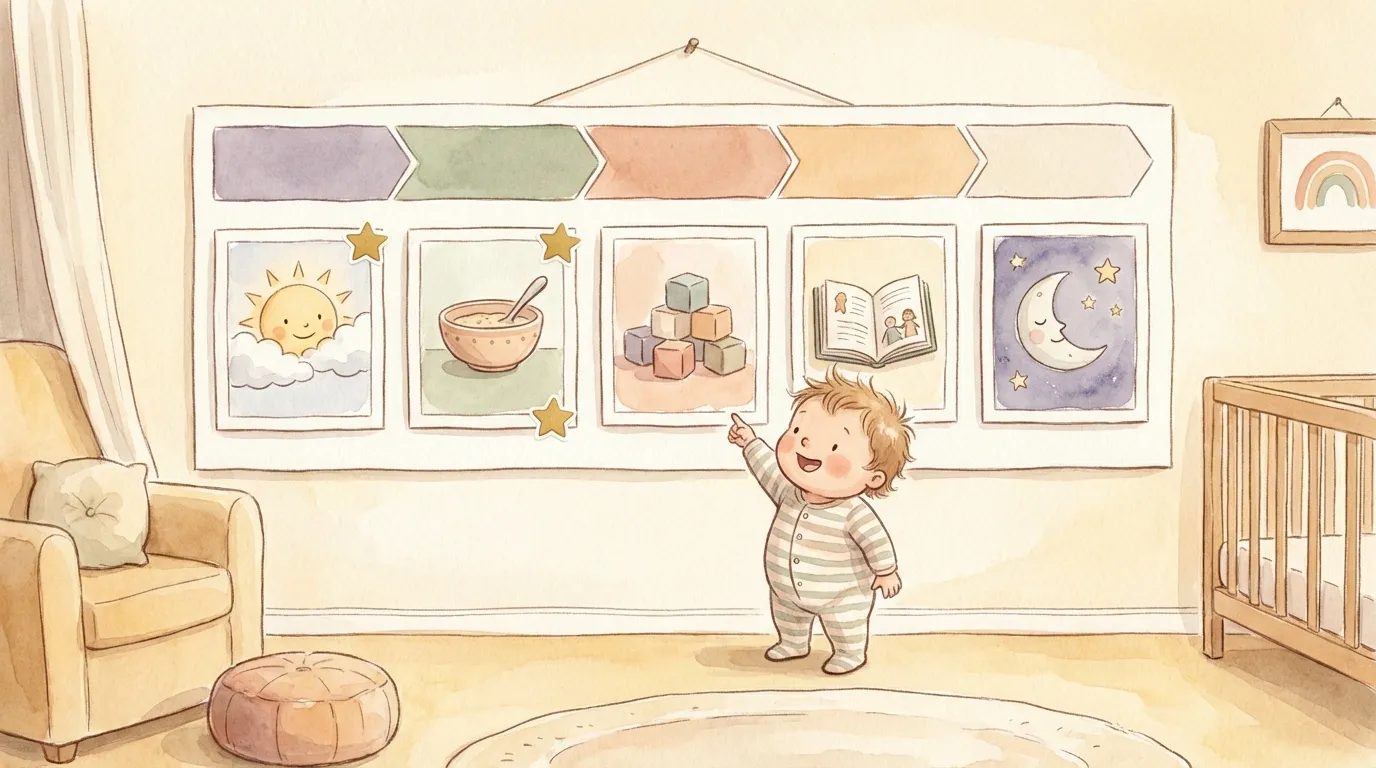
- Visual routine charts: Pictures, not words, showing each step in order. Let your child help make the chart. When they can “read” what comes next, they feel competent rather than bossed around.
- One instruction at a time: Instead of a list, give one step, wait for completion, then give the next. “First we put on pants. Great. Now let's find your shirt.”
- Wake up 15 minutes earlier than you think you need to: The number one cause of morning meltdowns is time pressure. When parents feel rushed, preschoolers feel it in their body and dysregulate faster.
- Prep the night before: Lay out clothes (let them choose between two options), pack bags, set the breakfast table. Every decision removed from the morning is one less potential conflict.
Mindell and Williamson found that a consistent bedtime routine was associated with better sleep outcomes, improved daytime behavior, and stronger parent-child attachment—benefits that extended well beyond the nighttime hours (Mindell & Williamson, 2018, Sleep Medicine Reviews, DOI: 10.1016/j.smrv.2017.10.007). The same principle applies to mornings: when children start the day with a predictable sequence, the emotional tone is set for everything that follows.
Transitions: The Hardest Part of a Preschooler's Day
If there is one thing that defines the preschool years, it is the transition struggle. Leaving the house. Coming inside from the playground. Stopping play for dinner. Turning off the screen. Getting in the bath. Getting out of the bath. For preschoolers, every transition is a tiny loss—the loss of the current activity, the current mood, the current world they were inhabiting.
Neuroscientists describe this as a problem of “mental gear-shifting”—the ability to move from one task or context to another. This skill is governed by the front part of the brain, which is one of the slowest regions to mature. Research by Zelazo and colleagues demonstrated that this kind of mental flexibility in preschoolers is still highly effortful and fragile—even children who can manage a transition when calm will fail at it when tired, hungry, or emotionally activated (Zelazo et al., 2003, Monographs of the Society for Research in Child Development, DOI: 10.1111/j.0037-976x.2003.00266.x).
Why transitions feel so hard
- Preschoolers experience time differently—“five more minutes” is meaningless when you cannot tell time
- They are fully absorbed in the present moment, which is actually a strength of this developmental stage
- The new activity feels uncertain even if it is something they usually enjoy
- Emotional regulation resources deplete across the day, making later transitions harder than early ones
Strategies that ease the shift
- Use a visual timer (a sand timer or color-changing clock) so they can “see” time passing
- Create a transition ritual: a specific song, a countdown, or a playful phrase like “boots on, adventure ready!”
- Give a two-minute and one-minute warning before every transition, every time, without exception
- Name what comes next positively: “After we clean up, we get to read our story”
Mealtime Struggles and Food Refusal
Picky eating in preschoolers is so common that researchers consider it a developmental norm rather than a problem behavior. Between ages two and five, roughly 50% of children go through a phase of strong wariness around new foods—a biologically driven reluctance to try unfamiliar tastes that likely evolved to protect newly mobile toddlers from poisoning themselves.
The problem is that modern mealtime often becomes a power struggle layered on top of this biological reality. A parent who is worried about nutrition pushes. A child who is wired to refuse digs in. The dinner table becomes a nightly negotiation that leaves everyone exhausted and nobody nourished—emotionally or physically.
Satter's Division of Responsibility model, considered the gold standard in pediatric feeding, offers a radical simplification: the parent decides what food is served, when, and where. The child decides whether to eat and how much. When parents consistently honor this division, pressure drops, food acceptance increases over time, and mealtimes become connection opportunities rather than conflict zones (Satter, 2007, Journal of Nutrition Education and Behavior, DOI: 10.1016/j.jneb.2007.01.006).
Building mealtime routines that work
- Same time, same place: Consistent meal and snack times help regulate hunger cues. Three meals and two snacks at predictable times prevents the grazing that kills appetite.
- Always include one safe food: Every meal should have at least one item you know your child will eat. This takes the survival panic out of the equation and lets them explore other foods without pressure.
- Remove the commentary: No praise for eating, no disappointment for refusing. Neutral presence at the table teaches your child that food is not a performance.
Bedtime Routines That Work
The bedtime routine is the single most studied routine in all of pediatric sleep research, and the evidence is overwhelming: a consistent, calming sequence of three to four steps performed in the same order nightly is the most effective non-medical intervention for childhood sleep difficulties. Mindell and colleagues found that consistent bedtime routines reduced sleep onset latency, night wakings, and parent stress within just two weeks (Mindell et al., 2015, Sleep,DOI: 10.5665/sleep.4662).
For preschoolers, the bedtime routine serves a dual purpose. It signals to the body that sleep is approaching (the physiological function), and it provides a predictable bridge between the togetherness of the day and the separation of the night (the emotional function). Both matter equally. A bath followed by pajamas followed by two stories followed by a song gives your child a roadmap from “awake and together” to “asleep and safe alone.”
For a deeper look at preschooler sleep challenges—fear of the dark, stalling tactics, night waking, and the nap transition—see our dedicated Sleep Guide for Ages 3–5.
How Stories Make Routines Feel Like Adventures, Not Chores
Preschoolers do not respond well to instructions. They respond to stories. This is not a parenting hack—it is a fundamental feature of how the young brain processes information. Between ages three and five, narrative thinking is the primary way of thinking. Children understand the world through characters, sequences, and emotional arcs, not through rules and explanations.
This is why telling a preschooler “you need to brush your teeth because sugar causes cavities” is far less effective than reading them a story where their favorite character brushes their teeth as part of a bedtime adventure. When a child sees a character who looks like them, lives in a room like theirs, and hugs the same stuffed animal they hug, that character's routine becomes a script they want to follow.
A review by Mar and Oatley found that narrative fiction uniquely activates the brain's simulation network, allowing readers to “practice” behaviors and emotional responses vicariously before encountering them in real life (Mar & Oatley, 2008, Perspectives on Psychological Science, DOI: 10.1111/j.1745-6924.2008.00073.x). For preschoolers, a story about a character who gets dressed, eats breakfast, and heads off to a fun day is not entertainment. It is rehearsal.
Frequently Asked Questions
Common questions parents ask.
Daily Routines at Other Ages
Routine challenges evolve as your child grows. Explore what to expect at every stage.
A Story That Makes Routines an Adventure
Create a personalized story featuring your child's name, their favorite toys, and gentle lessons about following daily routines with confidence. Designed for reading together with children ages 3 to 5.
Start Your Free Story