Focus & ADHD in Children Ages 3-5: When Energy Is Normal and When to Look Deeper
Your preschooler cannot sit still. They flit from one toy to the next. They interrupt, they climb, they seem to run on a motor that never switches off. Before you worry, know this: most of what you are seeing is exactly what a healthy preschool brain is supposed to do. This guide will help you understand what is typical, what deserves a closer look, and what actually helps — regardless of whether ADHD is part of your child's story.
What You'll Learn
- Preschoolers can typically sustain focus for only 3-5 minutes per year of age — short attention at this stage is developmentally normal, not a red flag.
- Reduce visual clutter and create a consistent "focus spot" to help your child engage longer without fighting distractions.
- Channel movement instead of eliminating it — bouncing on a cushion or holding a fidget toy actually improves a preschooler's ability to attend.
- Use structured play like puzzles, simple board games, and building challenges to build attention stamina in a way that feels like fun.
- If your child's activity level significantly exceeds all same-age peers across every setting and causes impairment, talk to your pediatrician.
What Does “Normal” Attention Look Like for Children Ages 3–5?
At ages 3–5, typical attention spans are short by design—most preschoolers can sustain focus for only 3 to 5 minutes per year of age. ADHD at this age is hard to diagnose because high energy, impulsivity, and short attention are developmentally normal. The key difference is consistency and severity: ADHD symptoms show up across all settings and significantly exceed what peers display.
The single most important thing to understand about preschool attention is this: it is supposed to be short. A typically developing three-year-old can sustain attention on an adult-directed task for roughly three to five minutes. By age five, that extends to about ten to fifteen minutes—under ideal conditions. These numbers surprise many parents, especially when the expectation at preschool is to sit for a twenty-minute circle time.
The front part of the brain—the part that manages attention, impulse control, and juggling information—is among the last areas to mature. At ages 3 to 5, it is still under active construction. This means that your child's ability to plan, focus, remember instructions, and shift between tasks is genuinely limited, not by choice but by how their brain is built (Best & Miller, 2010, Child Development, DOI: 10.1111/j.1467-8624.2010.01499.x).
What looks like “not paying attention” is often a child whose brain has simply hit its limit for that moment. And what looks like “hyperactivity” is often your child's built-in need for movement to help their brain actually take things in. Before age six, movement and learning are not separate activities. They are deeply intertwined.
Typical at this age
- Shifting between activities every few minutes
- Difficulty following multi-step instructions
- Needing physical movement during learning tasks
- Interrupting conversations impulsively
Worth a closer look
- Cannot engage with even preferred activities for more than 1-2 minutes
- Significantly more active than all same-age peers in all settings
- Impulsivity that consistently leads to safety risks
- Being asked to leave preschool or daycare due to behavior
ADHD Versus Typical Preschool Energy: How to Tell the Difference
This is the question that keeps parents up at night. The honest answer is that the line between typical preschool exuberance and early ADHD is genuinely blurry at this age. Both involve high energy, short attention, and impulsive behavior. The difference lies in degree, persistence, and impairment.
A typically energetic preschooler can be redirected. They can sit for a story they love. They can play cooperatively with peers for stretches. Their energy is high but contextual—it surges in exciting environments and calms in quiet ones. An ADHD preschooler, by contrast, often seems driven by a motor. Their activity level does not modulate with context. They are equally intense at a birthday party and at the library. Redirection works briefly but does not stick. They want to focus but their brain will not cooperate.
The critical factor is impairment. A child who is energetic but thriving at preschool, making friends, and sleeping well is probably developing normally. A child whose behavior is causing them to be excluded from activities, damaging their peer relationships, or resulting in daily negative feedback is experiencing impairment—and that deserves professional attention, regardless of whether it eventually receives an ADHD label.
Why Sitting Still Is Neurologically Hard at This Age
When we ask a preschooler to sit still, we are asking them to do something that goes against how their brain is built right now. At ages 3 to 5, the part of the brain that controls movement is more developed than the part that puts on the brakes. In other words, the gas pedal is fully formed before the brakes are installed.
Research on body awareness and learning shows that young children actually take in information better when they can move. Their balance and motion-sensing system has direct connections to the parts of the brain that control attention and alertness. This is why rocking, swinging, and bouncing are not distractions for preschoolers. They are ways your child's body helps their brain stay tuned in—something occupational therapists have documented extensively.
The implication is profound and practical: instead of trying to eliminate movement, we should channel it. A preschooler who can bounce on a cushion, hold a fidget toy, or stand at a table is far more likely to attend to a task than one who has been told to “sit still and listen.” The stillness command does not improve attention. It redirects all of their cognitive resources toward the impossible task of not moving, leaving nothing for actual learning.
Environmental Strategies That Support Focus
The most effective focus interventions for preschoolers are not techniques you teach your child. They are changes you make to the environment around them. A preschooler's attention is profoundly shaped by their surroundings, and small adjustments can produce dramatic results.
Reduce visual clutter
A room full of visible toys is a room full of competing attentional demands. Store toys in bins or behind cabinet doors and rotate what is available. When your child has three choices instead of thirty, their brain spends less energy filtering distractions and more energy engaging. Research on environmental design and attention in early childhood confirms that simpler environments produce longer and more focused play (Fisher et al., 2014, Psychological Science, DOI: 10.1177/0956797614533801).
Create a “focus spot”
Designate a specific area for focused activities—puzzles, coloring, reading, building. This does not need to be elaborate: a small table in a quiet corner with good lighting and minimal background noise. The consistency of the space teaches the brain that “this is where we concentrate.” Over time, simply going to the focus spot cues attentional readiness.
Turn off background screens
Background television reduces both the quality and duration of child play even when the child is not watching it. The intermittent sounds and visual changes pull attention involuntarily. If your child is playing, reading, or building, silence the screens in the room. This single change can measurably increase focused play time.
Use timers and transitions
Preschoolers struggle with transitions partly because they have no internal sense of time. Visual timers—ones that show time as a shrinking color block—externalize the concept and reduce anxiety about “when.” Pair the timer with a verbal preview: “When the red is gone, we will clean up and have snack.” Predictable transitions reduce meltdowns and keep attention on the current activity rather than worrying about what comes next.
Structured Play and Routine as Attention Scaffolding
You cannot teach a preschooler to focus by lecturing them about it. But you can build focus through play. Structured play—activities with a beginning, middle, and end, clear rules, and a satisfying outcome—is the gymnasium where attention grows.
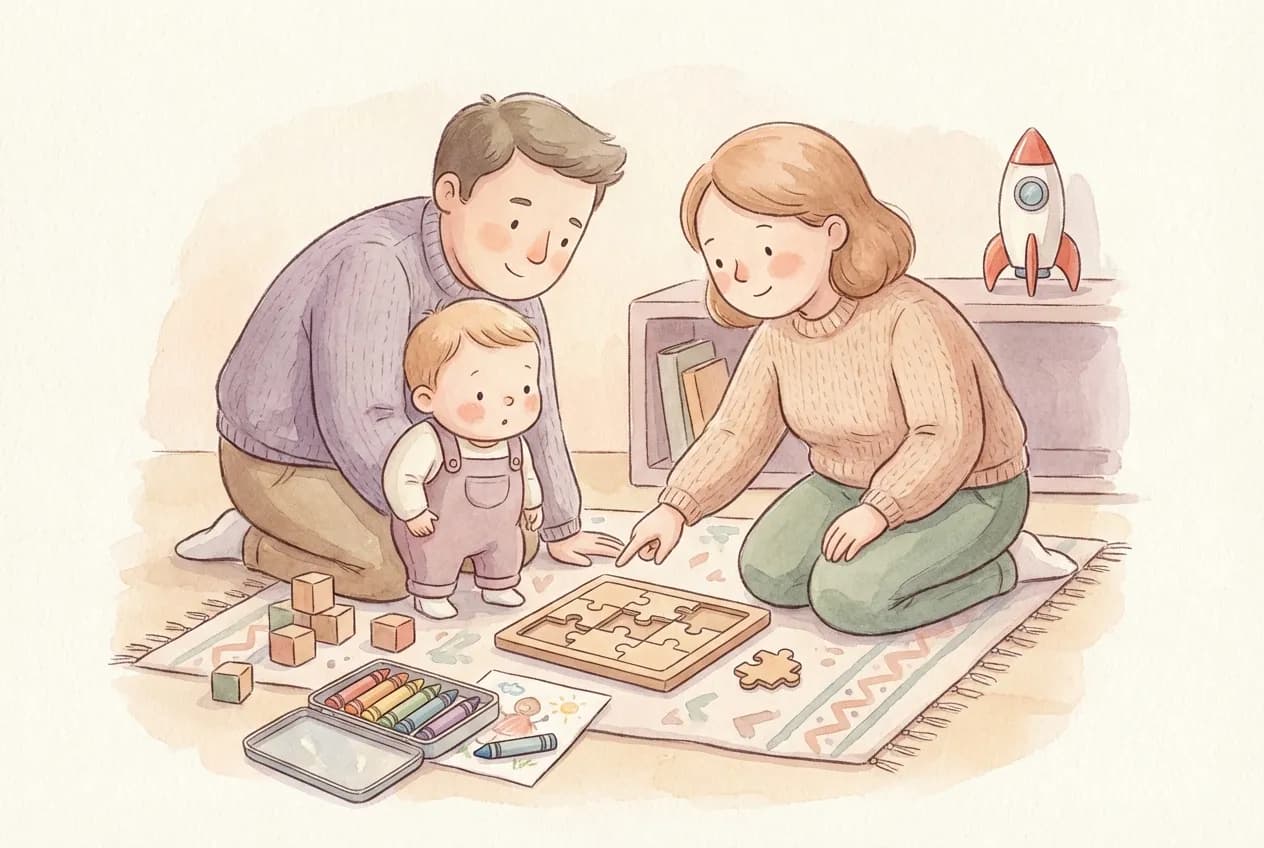
Puzzles, simple board games, building challenges (“Can you make a tower as tall as your knee?”), cooking together, and sorting games all exercise sustained attention in ways that feel like fun, not work. The key is matching the difficulty to your child's current capacity. A task that is too easy bores them; too hard and they give up. The sweet spot—challenging but achievable—is where focus muscles grow (Diamond & Lee, 2011, Science, DOI: 10.1126/science.1204529).
Daily routine is the other half of the attention scaffold. When the structure of the day is predictable—wake up, breakfast, play, snack, outside time, lunch, quiet time, activity, dinner, bath, story, bed—the child's brain does not need to spend cognitive resources figuring out what comes next. That freed-up bandwidth goes directly into engagement with the present activity. For more on building effective routines, see our guide to daily routines for children.
How Stories Help Restless Minds Learn to Be Present
Shared reading is one of the most powerful attention-building activities for preschoolers—and it may be the most underestimated. When you read a story with your child, you are asking their brain to do something sophisticated: hold a narrative thread, track characters, anticipate what comes next, and stay engaged across multiple pages. This is sustained attention practice wrapped in warmth and connection.
For the restless preschooler, the key is making stories irresistible. When the character shares your child's name, their favorite stuffed animal, and their specific challenge—whether that is sitting still at circle time or remembering to wait their turn—the story becomes magnetic. The child attends because the story is about them. And each time they follow a character through a challenge and out the other side, they are rehearsing both focus and resilience.
Research on stories and the brain suggests that reading fiction works like a mental rehearsal of real life—readers picture themselves in characters' situations, feel their emotions, and weigh their decisions, which deepens engagement (Mar & Oatley, 2008, Perspectives on Psychological Science, DOI: 10.1111/j.1745-6924.2008.00073.x). When the story is personalized, that simulation becomes even more absorbing. A personalized story does not just teach a lesson. It gives your child a reason to stay engaged, page after page. To learn more, explore our guide to bibliotherapy and personalized storytelling.
When to Talk to Your Pediatrician
High energy and short attention are the factory settings for a preschool brain. But there are signals that suggest something beyond typical development. Reach out for professional guidance when:
- Your child's activity level and impulsivity are significantly more intense than same-age peers across all settings
- They have been asked to leave or been expelled from a preschool or daycare program
- Impulsivity regularly puts them in physical danger despite appropriate supervision
- They cannot engage with any activity, including preferred ones, for more than one to two minutes
- Peers are beginning to avoid your child because of rough or unpredictable behavior
Raising a concern with your pediatrician is not labeling your child. It is making sure they get the support they deserve during a critical developmental window.
Frequently Asked Questions
Common questions parents ask.
A Story That Meets Your Preschooler Where They Are
Create a personalized story featuring your child's name, their favorite things, and characters who learn to focus, wait, and be present—one page at a time. Built for wiggly preschoolers, grounded in research.
Start Your Free Story