Focus & ADHD in Children Ages 6-8: Getting Through School, Homework, and Friendships
School changed everything. Suddenly your child is expected to sit at a desk for hours, follow multi-step instructions, wait their turn, and produce written work on demand — all things that ADHD makes genuinely harder. The report card says 'not working to potential.' You know better. They are working harder than anyone in that classroom. This guide is about understanding what they are up against and learning what actually helps.
What You'll Learn
- ADHD executive function development lags about 3 years behind peers, so your 7-year-old may have the self-regulation capacity of a typical 4-year-old.
- Break homework into 5-problem chunks with movement breaks between segments, and experiment with timing — right after school is often the worst window.
- Scaffold social skills through structured one-on-one playdates with activity-based formats like building projects or cooking, not unstructured free play.
- Lead teacher conversations with what works for your child rather than the diagnosis, and document all communications in writing.
- Combined treatment — behavioral strategies plus medical support when appropriate — produces the broadest positive outcomes across academic, social, and emotional measures.
How Do Classroom Expectations Clash With ADHD in Children Ages 6–8?
School introduces sustained sitting, focused attention, and impulse control demands that directly conflict with ADHD neurology in children ages 6–8. Homework battles emerge as executive function gaps become apparent, social impulsivity affects friendships, and the gap between ability and performance widens. Working with teachers and understanding school support options becomes essential.
The traditional classroom was designed for the neurotypical brain. Sit still. Listen quietly. Raise your hand. Wait your turn. Follow three-part directions from memory. For a child with ADHD, each of these expectations targets a skill their brain is specifically wired to struggle with.
This is not a matter of effort or intelligence. ADHD is a brain-based condition that affects the brain's management system—the part that handles attention, holding information in mind, impulse control, and getting started on tasks. Brain imaging research has shown consistent differences in how the front of the brain activates and how it uses dopamine in children with ADHD (Cortese et al., 2012, American Journal of Psychiatry, DOI: 10.1176/appi.ajp.2012.11101521). Your child is not choosing to be unfocused. Their brain is processing the world differently.
The CDC reports that approximately 9.8% of children ages 3 to 17 have received an ADHD diagnosis, with onset typically becoming most apparent during the early school years when academic and behavioral demands increase (Danielson et al., 2018, Journal of Clinical Child & Adolescent Psychology, DOI: 10.1080/15374416.2017.1417860). Ages 6 to 8 are often when families first receive a diagnosis, because this is when the gap between expectations and capacity becomes impossible to ignore.
What the classroom expects
- Sustained attention for 20–45 minute lessons
- Mental juggling to hold multi-step instructions
- Impulse control to wait, take turns, and raise a hand
- Task initiation and completion without constant prompting
What ADHD makes harder
- Filtering background noise and visual distractions
- Holding instructions in mind long enough to act on them
- Inhibiting responses that feel urgent in the moment
- Starting tasks that feel boring or overwhelming
Homework Battles and Executive Function
If homework is the nightly battlefield in your house, you are not alone. For children with ADHD, homework concentrates every executive function challenge into a single activity: they must initiate a task they did not choose, sustain attention without a teacher guiding them, manage their time, organize their materials, and persist through frustration. All of this after a full day of depleting their self-regulation reserves at school.
Think of your child's brain as having an air traffic control system. It coordinates planning, focus, and self-control all at once. In ADHD, this system is not broken—it is delayed. Research suggests that the brain's management skills in children with ADHD lag approximately 3 years behind their peers (Barkley, 1997, Psychological Bulletin, DOI: 10.1037/0033-2909.121.1.65). This means your 7-year-old with ADHD may have the planning and self-control capacity of a typical 4-year-old. Understanding this reframes homework struggles from laziness to how their brain is actually developing.
Break it down, then break it down more
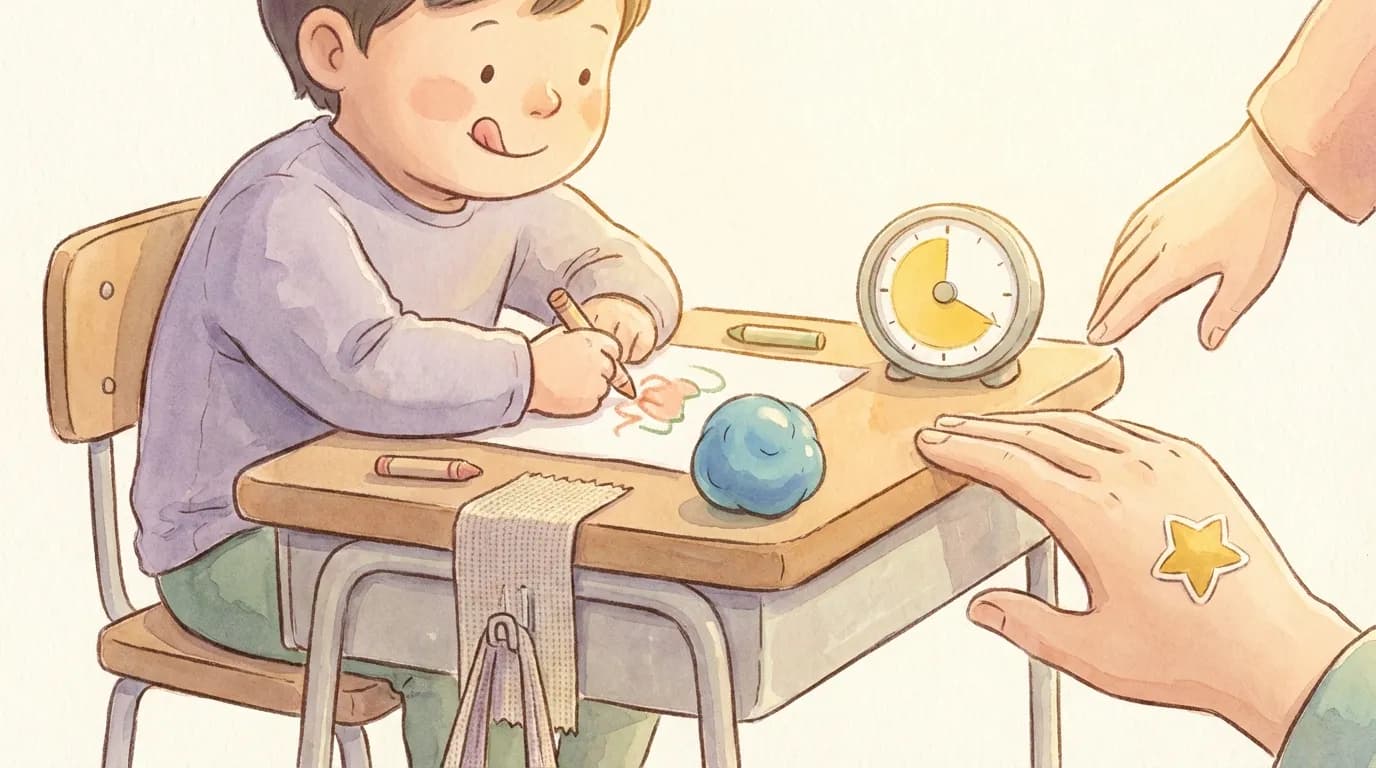
Instead of “Do your math,” say “Do problems one through five.” Then take a two-minute movement break. Then problems six through ten. A 20-problem worksheet is overwhelming. Five problems at a time is manageable. Each small completion gives the ADHD brain a dopamine hit that fuels the next segment.
Time it, but make it a game
A visual timer transforms an open-ended dread into a finite challenge. “Can you finish these five problems before the timer runs out?” turns homework into a game rather than a punishment. The urgency created by a timer also activates the ADHD brain's response to novelty and challenge, two things that naturally engage their attention system.
Rethink the timing
Immediately after school is often the worst time for homework. Your child has been holding it together for six hours, and their executive function tank is empty. A snack, physical play, and a genuine 30-minute break can refill the tank enough to make homework possible rather than torturous. Some families find that right after dinner or even early morning works best. Experiment until you find your child's optimal window. For more homework strategies, see our guide to homework battles.
The Social Impact of Impulsivity and Hyperactivity
For many parents, the social cost of ADHD is the most heartbreaking part. Your child wants friends desperately. But impulsivity makes them blurt out hurtful things without thinking. Hyperactivity makes them too intense for calmer peers. Difficulty reading social cues means they miss the signals that other children pick up on effortlessly. The birthday party invitations thin out. The phone stops ringing for playdates.
Research consistently shows that children with ADHD experience higher rates of peer rejection, and that this rejection can happen within minutes of meeting new children (Hoza et al., 2005, Journal of Consulting and Clinical Psychology, DOI: 10.1037/0022-006X.73.3.411). The rapid judgment happens because the ADHD behaviors that stand out most in social settings—interrupting, being too loud, invading personal space, not following game rules—are exactly the behaviors that peers find most off-putting.
This does not mean your child is destined for social isolation. It means they need more scaffolded social practice. One-on-one playdates in your home, where you can quietly coach, are more effective than group settings. Activity-based playdates (building projects, sports, cooking) reduce the demand for purely conversational social skills. And honest, compassionate debriefing after social interactions helps your child build awareness: “I noticed you talked over Jake a few times. How do you think that felt for him? What could you try next time?”
Working With Teachers and School Support
Your relationship with your child's teacher can be the most powerful lever for their school success or the most frustrating obstacle. The goal is partnership, and that starts with how you frame the conversation.
Lead with what you know about your child, not with a diagnosis. “She focuses best when she can sit near the teacher and when instructions are written down” is more actionable than “She has ADHD.” Bring solutions, not just problems. Pfiffner and Haack found that the most effective school interventions combine teacher strategies with strong parent-teacher communication (Pfiffner & Haack, 2014, Child and Adolescent Psychiatric Clinics of North America, DOI: 10.1016/j.chc.2014.05.014).
Classroom accommodations to request
- Preferential seating near the teacher, away from high-traffic areas
- Written instructions in addition to verbal directions
- Movement breaks between subjects or tasks
- Extended time on tests and in-class assignments
- Permission to use fidget tools that do not distract others
If you encounter resistance
Document all communications in writing. Request a formal evaluation if you have not already done so—the school must respond within a specific timeline. Explore whether a 504 plan or IEP would benefit your child. You have legal rights, and using them is not adversarial. It is advocacy. For a deep dive into school strategies, see our guide to helping your ADHD child focus at school.
The Medication Conversation
Few topics in parenting carry as much weight and emotion as the decision about ADHD medication. If you are wrestling with this question, you are doing exactly what a thoughtful parent should do. There are no easy answers, but there is good information.
The Multimodal Treatment Study of ADHD (MTA), the largest and longest treatment study ever conducted for childhood ADHD, found that carefully managed medication was more effective than behavioral treatment alone for core ADHD symptoms, and that combined treatment (medication plus behavioral strategies) produced the best outcomes across the broadest range of measures (MTA Cooperative Group, 1999, Archives of General Psychiatry, DOI: 10.1001/archpsyc.56.12.1073).
That said, medication is not the right choice for every child or every family. Some children respond beautifully to behavioral interventions alone. Some have side effects that outweigh benefits. Some families have philosophical or medical reasons for preferring non-pharmacological approaches. All of these positions are valid.
What matters most is that your decision is informed, not fearful. Talk to a pediatrician or child psychiatrist who specializes in ADHD. Ask about the specific medication being considered, its evidence base, common side effects, and how progress will be monitored. A good clinician will present medication as one tool in a well-rounded toolkit—not as a silver bullet and not as a last resort.
How Stories Channel Restless Energy and Build Focus Stamina
A child with ADHD who cannot sit through a 45-minute lecture may devour a story about a character who shares their exact struggle. This is not a contradiction. It is the difference between imposed attention and earned engagement. When the content is personally meaningful, the ADHD brain lights up in ways that generic content cannot achieve.
Personalized stories for children with ADHD work on multiple levels simultaneously. The narrative itself builds sustained attention—each chapter is a focus workout, getting slightly longer as your child's stamina grows. The characters model specific strategies for managing impulsivity, waiting, and staying on task. And because the character shares your child's name, their interests, and their specific challenges, the strategies feel personally relevant rather than preachy.
Research on what happens when we get deeply absorbed in a story shows that this state can shift beliefs and attitudes, making story-based experiences influence real-world thinking similarly to direct experience (Green & Brock, 2000, Journal of Personality and Social Psychology, DOI: 10.1037/0022-3514.79.5.701). When your child is truly “lost” in a story about a character getting through a tough school day, the strategies and perspectives they encounter can carry over into how they think and act in their own life. This is practice for real life, delivered in a form their brain is wired to absorb. Learn more in our guide to personalized stories for ADHD.
Frequently Asked Questions
Common questions parents ask.
Stories That Build Focus and Confidence
HeroMe creates personalized stories that work with your child's ADHD brain. Short chapters, high engagement, and characters who learn to face the same challenges your child deals with at school every day.
Start Your Free Story