Self-Esteem in Children Ages 3-5: How Confidence Begins
Your preschooler dumps a cup of milk and looks at you with wide eyes. They drop a block tower and shout 'I can't do anything!' They refuse to try the slide because 'I'm too little.' These moments feel small, but they are not. They are your child's first encounters with self-doubt — and your response to them is shaping how they will see themselves for years to come.
What You'll Learn
- Between ages 3 and 5, children form their earliest sense of self through what they can do and how caregivers react to their attempts.
- Use process praise ("You kept trying!") instead of person praise ("You're so smart!") to build effort-based confidence.
- Resist the urge to rescue: let your preschooler struggle with age-appropriate tasks so they can experience mastery firsthand.
- Stay calm during failures and be specific during successes — your emotional reactions teach your child whether mistakes are catastrophic or manageable.
- Self-esteem patterns established in early childhood tend to persist, making this a critical window for building a foundation of genuine confidence.
How Does Self-Esteem Develop in Children Ages 3–5?
Between ages 3 and 5, children form their earliest sense of who they are—a foundational feeling of “I am capable” or “I can't do it.” Self-esteem at this age is shaped primarily by how caregivers respond to attempts, failures, and emotions. Process praise, manageable challenges, and your calm reactions during frustration build the foundation for lifelong confidence.
Between ages three and five, something extraordinary happens in your child's mind. They begin to build a mental picture of who they are, what they can do, and how the world sees them. This is not abstract philosophy. It is a real turning point in how your child thinks—and it shapes everything that follows.
Research by Susan Harter (2012, The Construction of the Self: Developmental and Sociocultural Foundations, Guilford Press) shows that preschoolers form their sense of self almost entirely through two channels: what they can do and how the important people in their lives react to what they do. At this age, self-evaluation is all-or-nothing. A child does not think “I am moderately good at puzzles.” They think “I am good at puzzles” or “I am bad at puzzles.” There is no middle ground yet.
This black-and-white thinking means that preschoolers are both remarkably optimistic and remarkably fragile. A three-year-old will announce with total conviction that they can fly. But a single failed attempt at tying their shoes can reduce them to tears and the declaration that they “can't do anything.” Both responses are developmentally normal. Both are your child trying to figure out where they stand in a world that is still largely a mystery.
Longitudinal research by Robins and Trzesniewski (2005, Current Directions in Psychological Science, DOI: 10.1111/j.0963-7214.2005.00353.x) found that self-esteem trajectories established in early childhood tend to persist. The patterns your child forms now about whether they are capable, lovable, and worthy of effort do not simply vanish when they start school. They become the foundation on which all later confidence is built.
Why Preschoolers Say “I Can't Do It”—and Why That Is Normal
Few phrases alarm parents more than hearing their young child say “I can't do it” or “I'm not good at this.” It sounds like defeat. It sounds like low self-esteem. But in most cases, it is something far more ordinary: developmental frustration.
Between ages three and five, the gap between what a child wants to do and what their motor skills, language, and cognition can actually accomplish is enormous. They can envision the block tower they want to build but lack the fine motor precision to stack it. They can imagine drawing a dog but produce something unrecognizable. They can see older children riding bikes but cannot yet coordinate their legs on the pedals. This gap between intention and ability is the source of most “I can't do it” moments.
What it sounds like
- “I can't do it!” (before or during a challenging task)
- “It's too hard. You do it.”
- “I'm not good at anything.”
- Refusing to try new activities or giving up after one attempt
- Meltdowns when a project does not look “right”
What it actually means
- “This is harder than I expected and I do not know what to do with this feeling.”
- “I need to know you still believe in me.”
- “I am comparing my result to what I imagined, and it does not match.”
- “I have not developed the frustration tolerance to keep going yet.”
- “I need this task broken into smaller pieces.”
Research on self-efficacy in young children by Bandura (1997, Self-Efficacy: The Exercise of Control, W.H. Freeman) shows that children's beliefs about their own capabilities are shaped primarily by experiences of succeeding at challenging tasks. The crucial word is “challenging.” Tasks that are too easy do not build confidence. Tasks that are too hard create defeat. The sweet spot is what researchers call the “just-right challenge”: tasks your child cannot do alone but can accomplish with just enough support.
The Role of Praise: Process vs. Person
How you respond to your preschooler's accomplishments—and their failures—is one of the most powerful forces shaping their self-esteem. And the research here is both surprising and practical.
In their landmark study, Mueller and Dweck (1998, Journal of Personality and Social Psychology, DOI: 10.1037/0022-3514.75.1.33) found that children praised for intelligence (“You're so smart!”) responded very differently to later challenges than children praised for effort (“You worked really hard on that!”). The intelligence-praised children avoided difficulty, lied about their scores, and showed declining performance. The effort-praised children sought out challenges and improved over time.
This finding has been replicated extensively. Gunderson and colleagues (2013, Child Development, DOI: 10.1111/cdev.12064) followed families from when children were fourteen months old and found that the type of praise parents used during toddlerhood predicted children's motivational frameworks five years later. Parents who used more process praise (“good throwing!”) had children who were more likely to believe that ability could grow through effort.
Person praise (avoid)
- דYou're so smart!”
- דYou're such a good artist!”
- דYou're a natural!”
Process praise (use often)
- “You kept trying even when it was hard. That takes guts.”
- “I noticed you tried a different way when the first one did not work.”
- “You practiced that so many times. Look how much better it is now!”
The difference is not semantic. Person praise labels the child. Process praise describes what the child did. When a child hears “you're so smart,” they learn that their worth is tied to being smart—and every future struggle becomes a threat to that identity. When they hear “you worked hard,” they learn that effort is what matters—and struggle becomes proof of effort, not evidence of inadequacy.
How Your Reactions Shape Their Self-Image
Preschoolers are extraordinary mirrors. They do not yet have a stable internal sense of who they are, so they look outward—primarily to you—to understand themselves. Research by Cooley and later by Harter confirms what parents intuit: your child sees themselves, in large part, through your eyes.
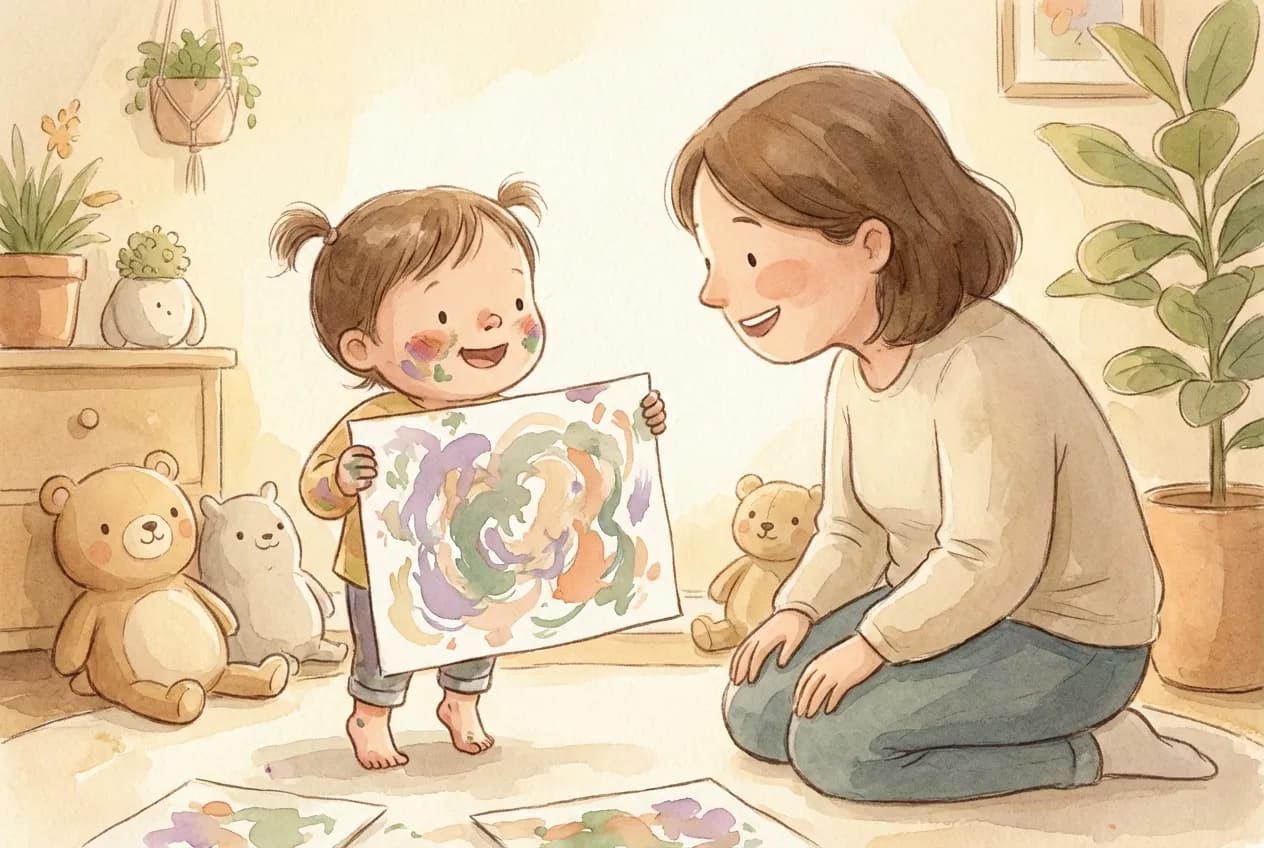
This means that the micro-moments matter enormously. When your child spills the milk and you sigh and clean it up silently, they learn something different than when you say “Oops! Spills happen. Here, let's wipe it up together.” When they bring you a scribbled drawing and you glance at it and say “nice,” they absorb something different than when you sit down and ask “tell me about this part.”
When they fail, stay calm
Your emotional reaction to your child's mistakes teaches them whether failure is catastrophic or manageable. If you rush to fix things, they learn that mistakes are emergencies. If you stay calm and curious, they learn that mistakes are information. This is not about being perfect. It is about being aware that your three-year-old is reading your face for data about who they are.
When they struggle, resist rescuing
The instinct to help is loving, but doing everything for your preschooler sends an accidental message: “You cannot handle this.” Instead, narrate their effort: “I can see you are working hard on that zipper. You almost have it.” Offer just enough support to keep them going without taking over. Every task they complete with minimal help deposits confidence.
When they succeed, be specific
Rather than a generic “good job,” name what you actually noticed. “You stacked those blocks all the way to the top and they did not fall. You figured out how to balance them!” Specific feedback tells your child exactly what they did well, making the success repeatable rather than mysterious. As Dweck's research shows (2006, Mindset: The New Psychology of Success), this specificity is what builds a growth mindset from the earliest years.
Building Resilience Through Manageable Challenges
Confidence is not built by telling children they are wonderful. It is built by giving them opportunities to discover that they are capable. For preschoolers, this means creating a steady stream of manageable challenges—tasks that stretch their abilities without overwhelming them.
- Pouring their own water (from a small pitcher)
- Putting on their own shoes (even if they are on the wrong feet)
- Helping set the table (one item at a time)
- Choosing their own clothes for the day
- Cleaning up their toys with a clear system
- Puzzles with slightly more pieces than last time
- Simple cooking tasks (stirring, pouring, counting ingredients)
- Drawing something specific and comparing it to their earlier drawings
- Exploring a new playground with your calm presence nearby
- Ordering their own food at a restaurant
The key insight from Bandura's research on belief in one's own ability is that watching others succeed and hearing encouragement can help, but they cannot replace the real thing. You can tell your child they are capable a thousand times, but nothing substitutes for the moment they actually do it themselves—pour the milk without spilling, climb the ladder they were afraid of, or finish the puzzle they almost gave up on. That is when confidence becomes real.
How Personalized Stories Help Children See Themselves as Capable
Preschoolers live in the world of stories. They do not learn confidence from lectures or pep talks. They absorb it through narrative—through watching characters they identify with face challenges, persist, and grow. This is why personalized storytelling is one of the most powerful tools for building self-esteem at this age.
Research on bibliotherapy with young children confirms this. A systematic review by Montgomery and Maunders (2015, Children and Youth Services Review, 55, 37–47, DOI: 10.1016/j.childyouth.2015.05.010) found that story-based interventions significantly improved children's emotional and behavioral outcomes, including how they see themselves. The effect was particularly strong when stories featured characters facing problems similar to the child's own experience.
What makes personalized stories different from simply reading any picture book is personalization. When a story features a character with your child's name, their favorite stuffed animal, and the specific challenge they face—the narrative becomes a safe rehearsal space. Your child watches “themselves” struggle, persist, and succeed. They begin to internalize not just the outcome but the process: “Someone like me kept trying, and it worked.”
This is particularly effective at ages three to five because children at this stage cannot yet separate themselves from story characters in the way older children can. The identification is total. When the character feels proud, your child feels proud. When the character discovers they are braver than they thought, your child absorbs that belief into how they see themselves. For a deeper exploration of this approach, see our complete guide to bibliotherapy.
Frequently Asked Questions
Common questions parents ask.
A Story Where Your Child Discovers They Are Brave
Create a personalized story featuring your child's name, their favorite comfort objects, and the specific challenges they face. Designed for preschoolers, grounded in research, made for bedtime.
Start Your Free Story