Self-Esteem in Tweens Ages 9-12: Identity, Comparison, and Confidence
Your tween is in the bathroom, staring at the mirror. Or hunched over their phone, scrolling through a feed of curated perfection. Or sitting at the kitchen table, paralyzed by a homework assignment because if it is not perfect, it is not worth submitting. They are not just growing up. They are trying to answer the most destabilizing question of their young life: 'Who am I, and am I enough?'
What You'll Learn
- Tweens ages 9-12 shift from comparing specific abilities to comparing entire identities, making the comparison trap far more destabilizing.
- Perfectionism at this age is often a sign of fragile self-worth, not high standards — address the underlying fear of being "not enough."
- Help your tween develop a growth mindset by framing struggle as how capable people learn, and adding "yet" to "I can't" statements.
- Girls tend to internalize self-esteem challenges through self-criticism and appearance concerns, while boys often externalize through withdrawal or dismissiveness — both need attention.
- Stories work powerfully with tweens because they bypass resistance to direct advice and provide an indirect mirror for self-reflection and identity building.
How Do Social Media and Appearance Affect Self-Esteem in Children Ages 9–12?
For children ages 9–12, social media and appearance-based comparison become significant threats to self-esteem. The comparison trap intensifies as tweens develop abstract thinking, perfectionism rises, and identity development begins in earnest. Understanding gender differences in how self-esteem challenges manifest helps parents provide targeted support.
The tween years have always been a vulnerable period for self-esteem. But today's tweens face something no previous generation has encountered: a constant, algorithmically curated feed of other people's best moments, filtered appearances, and performed confidence. And they carry it in their pocket.
Research by Kelly, Zilanawala, Booker, and Sacker (2018, EClinicalMedicine, DOI: 10.1016/j.eclinm.2018.12.005) found that social media use was significantly associated with lower self-esteem in adolescents, with the strongest effects operating through social comparison and appearance-related feedback. For tweens who are already dealing with the physical changes of early puberty, the message is relentless: your value is tied to how you look, how many likes you get, and how your life compares to the highlight reels of your peers.
The impact is not hypothetical. A large-scale study by Twenge et al. (2019, Journal of Abnormal Psychology, DOI: 10.1037/abn0000410) documented a significant increase in depression, anxiety, and suicide-related outcomes among adolescents coinciding with the rise of smartphone and social media use. The increase was steeper for girls, but boys were not unaffected—they simply experienced it through different channels, including gaming performance, physical strength, and athletic comparison.
The Comparison Trap and the Rise of Perfectionism
Social comparison is not new at this age—it has been building since the early school years. But between nine and twelve, it becomes more sophisticated, more internalized, and more damaging. Younger children compare specific abilities (“she runs faster than me”). Tweens compare entire identities (“she is more popular, prettier, and smarter than me, and my life is worse”).
This global comparison often fuels perfectionism—not the healthy kind of high standards, but the paralyzing kind where your child believes everyone around them demands perfection. Curran and Hill (2019, Psychological Bulletin, DOI: 10.1037/bul0000138) documented a significant generational increase in perfectionism among young people, with the belief that others demand perfection from you showing the steepest rise. This is the perfectionism that says: “If I am not perfect, I am worthless.”
What perfectionism looks like in tweens
- Spending hours on assignments that should take thirty minutes
- Erasing and rewriting work repeatedly
- Meltdowns over grades that are objectively good but not perfect
- Refusing to submit work or turn in assignments at all
- Avoiding new activities for fear of not being immediately good at them
- Harsh self-criticism: “I'm so dumb,” “Why can't I just be normal?”
The irony of perfectionism is that it does not produce excellence. It produces paralysis. The tween who cannot submit an imperfect assignment is not aiming high—they are terrified of being seen as inadequate. Understanding this distinction is crucial for parents, because the solution is not lowering standards. It is changing the basis of self-worth from outcomes to effort and growth. For more on this, see our guide on the comparison trap and how to help your child escape it.
“Who Am I?”—Identity Development in the Tween Years
Between ages nine and twelve, children undergo a thinking shift that fundamentally changes how they see themselves. They move from concrete self-descriptions (“I have brown hair, I like soccer”) to abstract ones (“I am shy, I am not as smart as my friends, I do not know who I am”). This is the beginning of what Erikson called the “identity crisis”—though for tweens, it is less a crisis and more a slow unraveling of childhood certainties.
Research by Harter (2012, The Construction of the Self, Guilford Press) found that tweens develop the ability to hold contradictory self-views for the first time. They can recognize that they are confident with friends but anxious with strangers, or capable at sports but failing at math. This capacity for nuance is a cognitive achievement, but it also introduces a new kind of distress: inconsistency. “Which one is the real me?” is a question that younger children never ask. Tweens ask it constantly, usually without words.
This identity work is complicated by the pressure to fit in. Tweens are simultaneously trying to figure out who they are and trying to figure out who they need to be in order to be accepted. When those two goals conflict—when being authentically themselves risks social rejection—self-esteem suffers. The tween who loves reading but hides their book because “it's nerdy” is making a self-esteem trade: acceptance in exchange for authenticity. That trade always costs more than it seems.
Academic Pressure and the Fixed Mindset
As schoolwork becomes more demanding in the tween years, how your child feels about their abilities often takes a hit. The child who coasted through elementary school on natural ability may encounter real difficulty for the first time in fourth or fifth grade—and if they have been praised primarily for being smart, they have no framework for handling the struggle. “I used to be good at this. Now I am not. Therefore I must be getting dumber.”
Dweck's research on fixed versus growth mindset (2006, Mindset: The New Psychology of Success) is particularly relevant here. Tweens with a fixed mindset believe that their abilities are set in stone. When they fail, they conclude that they have reached their limit. Tweens with a growth mindset believe that abilities can be developed through effort. When they fail, they look for a new strategy.
- “I'm just not a math person.”
- “Why bother studying? I'll fail anyway.”
- Cheating to maintain the appearance of competence
- Refusing to ask for help because it “proves” they are dumb
- Performance anxiety that leads to test-day stomachaches
- “I do not get this yet. Can you explain it differently?”
- “That test was hard. I need to study this part more.”
- Willingness to make mistakes publicly
- Asking for help as a strategy, not as an admission of failure
- Viewing effort as the path to improvement, not a sign of weakness
The tween years are a critical window for mindset intervention because beliefs about intelligence are solidifying. Research by Yeager and Dweck (2012, Educational Psychologist, DOI: 10.1080/00461520.2012.722805) found that brief growth mindset interventions significantly improved academic outcomes and resilience in adolescents, particularly those who were struggling. The message that “your brain is like a muscle that gets stronger with exercise” resonates deeply with tweens who are beginning to understand how effort and outcomes relate.
Gender Differences in Self-Esteem Expression
One of the most consistent findings in self-esteem research is that the gender gap in self-esteem widens significantly during the tween years. Kling and colleagues (1999, Psychological Bulletin, DOI: 10.1037/0033-2909.125.4.470) found that while the gender difference in self-esteem is small in childhood, it grows substantially during early adolescence, with girls showing steeper declines. But the full picture is more nuanced than “girls lose self-esteem and boys do not.”
Girls tend to experience self-esteem challenges by turning inward: self-criticism, appearance dissatisfaction, social anxiety, and the pressure to be “perfect.” They are more likely to express their struggle verbally (“I hate how I look”) and to seek reassurance from friends and parents. The social comparison dynamics of girl friendships at this age—the constant negotiation of inclusion and exclusion—can be particularly corrosive to self-worth.
Boys tend to externalize self-esteem challenges: withdrawal from activities, aggressive behavior, dismissiveness (“this is stupid, who cares”), and performance-based identity (“I'm only worth something if I win”). Because boys are socialized to suppress vulnerability, their self-esteem struggles are often invisible to adults until they manifest as behavioral problems, academic decline, or emotional shutdown.
Regardless of gender, the core need is the same: tweens need to know that their worth is not contingent on their appearance, their performance, or their popularity. They need adults who see and value them for who they are becoming, not just what they achieve.
How Stories Provide a Safe Mirror for Self-Reflection
Tweens are notoriously resistant to direct advice about their feelings. Tell a twelve-year-old “you should feel better about yourself” and you will get an eye roll or silence. But give them a story about a character facing the same questions they face—who am I, am I enough, what do I do when the world says I should be different—and something opens.
Research on how personal stories shape us by McAdams and McLean (2013, Current Directions in Psychological Science, DOI: 10.1177/0963721413475622) shows that adolescents are actively constructing their life stories, and the stories they encounter shape this construction. When a tween reads about a character who wrestles with self-doubt, tries different approaches to a problem, and discovers that their value does not depend on being perfect or popular, they are not just being entertained. They are absorbing an alternative framework for understanding themselves.
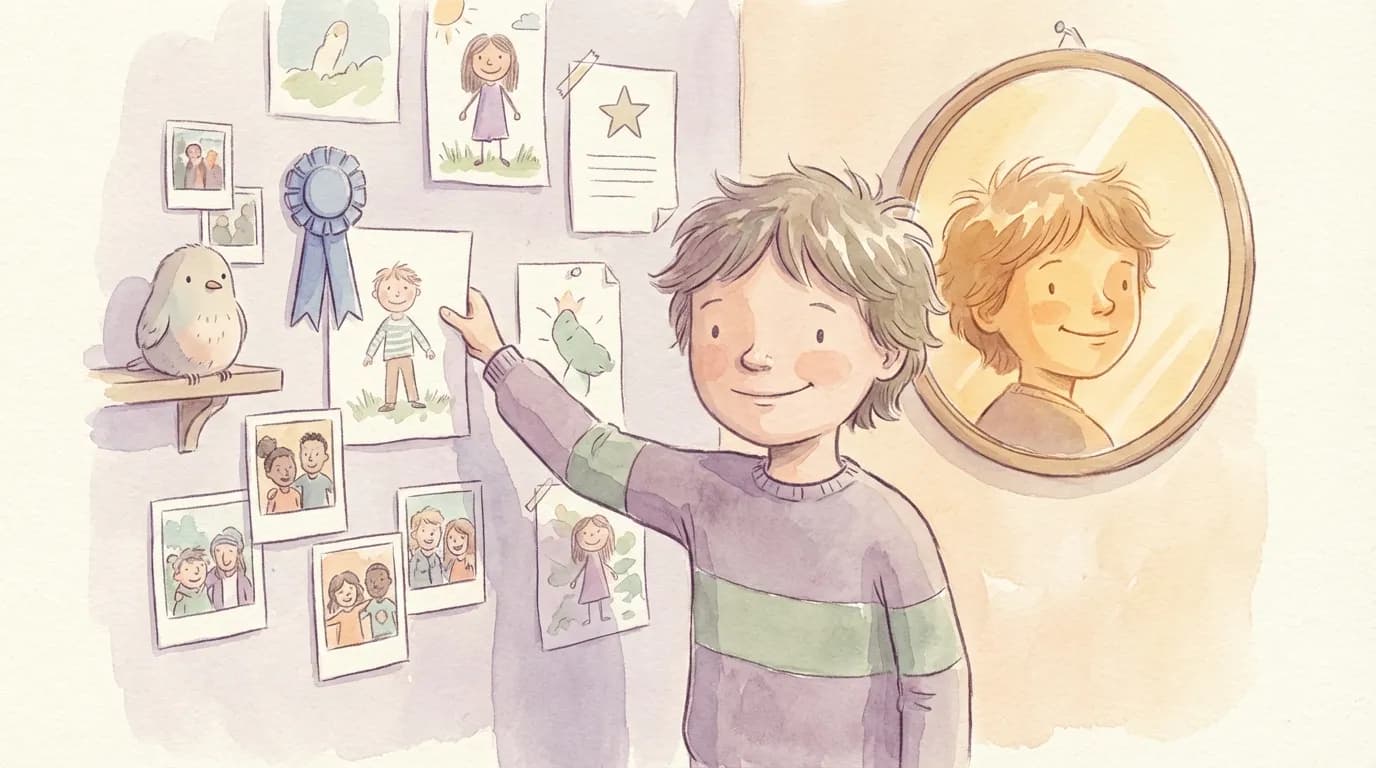
Personalized storytelling at this age works precisely because it is indirect. The story does not lecture. It does not say “believe in yourself.” Instead, it creates a character who shares the tween's world—their name, their interests, their specific struggles—and places them in a narrative where growth happens through authenticity and persistence, not perfection. For a tween who is building their identity in a world that rewards comparison and performance, this is revolutionary: a mirror that shows them not who they should be, but who they already are.
For more on how narrative interventions work across ages, see our complete guide to bibliotherapy. To understand how self-esteem develops before the tween years, explore our guides for ages 3–5 and ages 6–8.
Frequently Asked Questions
Common questions parents ask.
A Story That Meets Your Tween Where They Are
Create a personalized story where your tween—by name, with their world and their real questions—discovers that who they are is already enough. Not a lecture. Not advice. A mirror. Built on research. Designed for bedtime.
Start Your Free Story