Sleep Challenges in Children Ages 6\u20138: When School Changes Everything
Your child started school and suddenly bedtime is a battlefield, mornings are a struggle, and somewhere between homework and nightmares, everyone in the house is exhausted. School does not just change your child\u2019s days\u2014it fundamentally restructures their nights. Here is what is happening and what actually helps.
What You'll Learn
- Starting school forces a wake-up time that often does not match your child’s natural rhythm, and the sleep debt adds up fast.
- Nightmares and night terrors both peak at ages 6 to 8 but need opposite responses—comfort and dream-rewriting for nightmares, patient waiting for night terrors.
- What your child watches before bed matters as much as when they stop watching—an exciting show fires up the brain more than the screen light itself.
- Build toward sleepover confidence gradually with "late-overs" and family sleepovers before trying a full sleepover at a friend’s house.
- Ten minutes of undivided connection at bedtime—reading together or quiet conversation—does more for your child’s sleep than any other single change.
How Does School Restructure Sleep for Children Ages 6–8?
Starting school forces children ages 6–8 into a rigid wake-up time that may not match their natural rhythm. Early mornings, after-school activities, and homework squeeze the evening down, leaving less time to wind down. Nightmares and night terrors peak during this period, and screen time increasingly gets in the way of the brain's sleep signals.
Before school, your child's sleep schedule was largely shaped by biology. They slept when they were tired, woke when they were rested. School introduces something entirely new: an externally imposed wake time that pays no attention to your child's natural rhythm.
For many six-year-olds, a 6:00 or 6:30am alarm is a big jump from when they naturally want to wake up. This is not a small thing. Owens and Mindell's review of children's sleep problems describes how school-age children who are woken up well before their body is ready start building up a sleep debt that shows up as trouble concentrating, bigger emotional reactions, and—ironically—more bedtime resistance (Owens & Mindell, 2011, Pediatric Clinics of North America, DOI: 10.1016/j.pcl.2011.03.011).
On top of the early wake-up, your child is spending six or seven hours navigating friendships, following rules, processing new information, and managing their behavior. By evening, their brain is exhausted and wound up at the same time—a combination that makes falling asleep genuinely hard.
Nightmares vs. Night Terrors: The Peak Years
Ages six through eight are the peak years for both nightmares and night terrors, though the two are completely different things. Knowing which one your child is having changes everything about how you respond.
Nightmares are scary dreams that happen later in the night. Your child wakes up fully, remembers what happened, wants comfort, and may not want to go back to sleep. Night terrors are completely different—they happen earlier in the night, usually within two hours of falling asleep. Your child may scream, thrash, or look absolutely terrified, but they are not actually awake and will not remember any of it in the morning.
Research shows that night terrors peak between ages four and eight, affecting up to 40% of children in this window, while nightmares pick up from age six as your child's brain becomes capable of more complex, story-like dreams. Both get worse when your child is overtired, which is why improving overall sleep often reduces both.
When it is a nightmare
- Offer comfort and stay until your child is calm
- Help them rewrite the dream ending: “What if the dragon became friendly?”
- Avoid dismissing the fear—the dream felt completely real to them
- If nightmares are recurring, consider what daytime stressors may be fueling them
When it is a night terror
- Do not try to wake your child—it will prolong the episode
- Stay nearby to prevent injury but avoid restraining them
- The episode will pass in 5 to 15 minutes
- Address sleep deprivation: an earlier bedtime often eliminates night terrors entirely
Screen Time and Sleep Quality
The screen-sleep connection at this age is not just about the light from the screen interfering with the brain's sleep signals, though that is part of it. A review by Hale and Guan found three ways screens disrupt children's sleep: the exciting content itself (action shows, games, social media previews) fires up the brain, screens push bedtime later simply by eating up the evening, and the blue-toned light from the screen suppresses the brain's natural sleep signals (Hale & Guan, 2015, Sleep Medicine Reviews, DOI: 10.1016/j.smrv.2014.07.007).
Of these three, what your child watches may matter most at ages six through eight. A child who watches a calm nature show and a child who plays an exciting video game will arrive at bedtime in very different states, even if both stop at the same time. What your child watches matters as much as when they stop watching.
A realistic screen-sleep plan
- Create a “screens off” ritual 30 to 60 minutes before bed. Make it a clear transition: devices go to a charging station outside the bedroom, then the bedtime routine begins.
- Replace screens with connection. The 30 minutes after screens go off is prime time for reading together, talking about the day, or a calm card game. This buffers the stimulation and provides the bedtime connection school-age children still deeply need.
- No screens in the bedroom. This is the single most impactful rule. Children with devices in their bedrooms sleep an average of 20 minutes less per night than those without.
Sleepover Anxiety: The Hidden Sleep Challenge
Sleepovers occupy a strange space in childhood. They are a social milestone, a badge of growing up—and for many six- to eight-year-olds, a source of genuine dread. The child who sleeps fine in their own bed may be terrified of sleeping somewhere unfamiliar, where the sounds are different, the bed is different, and their parents are unreachable.
This is not a sign of weakness or being too dependent. It is completely normal for their age. Your child has built their sense of nighttime safety around specific things: their bed, their room, the sounds of their house, knowing you are nearby. Take all of that away at once, and the feeling of safety wobbles.
Gregory and Sadeh's review of sleep problems in childhood highlights the broad connection between sleep disruption and emotional difficulties, noting that environmental factors play an important role in children's sleep quality (Gregory & Sadeh, 2015, Journal of Child Psychology and Psychiatry, DOI: 10.1111/jcpp.12469). For children at this age, sleeping somewhere unfamiliar can be a common trigger for bedtime anxiety. The best approach is building up to it gradually rather than pushing your child into a full sleepover before they are ready.
Building toward sleepover confidence
- Start with “late-overs”—your child stays at a friend's house until 8 or 9pm, then comes home to sleep in their own bed.
- Practice with family sleepovers first—grandparents, aunts and uncles, or close family friends where your child already feels safe.
- Send familiar sleep anchors: their own pillow, a blanket from home, their comfort object. These are not babyish—they are portable pieces of nighttime security.
- Establish a no-shame pickup policy: “You can call me at any time, for any reason, and I will come get you. No questions asked.”
Growing Independence, Enduring Need for Connection
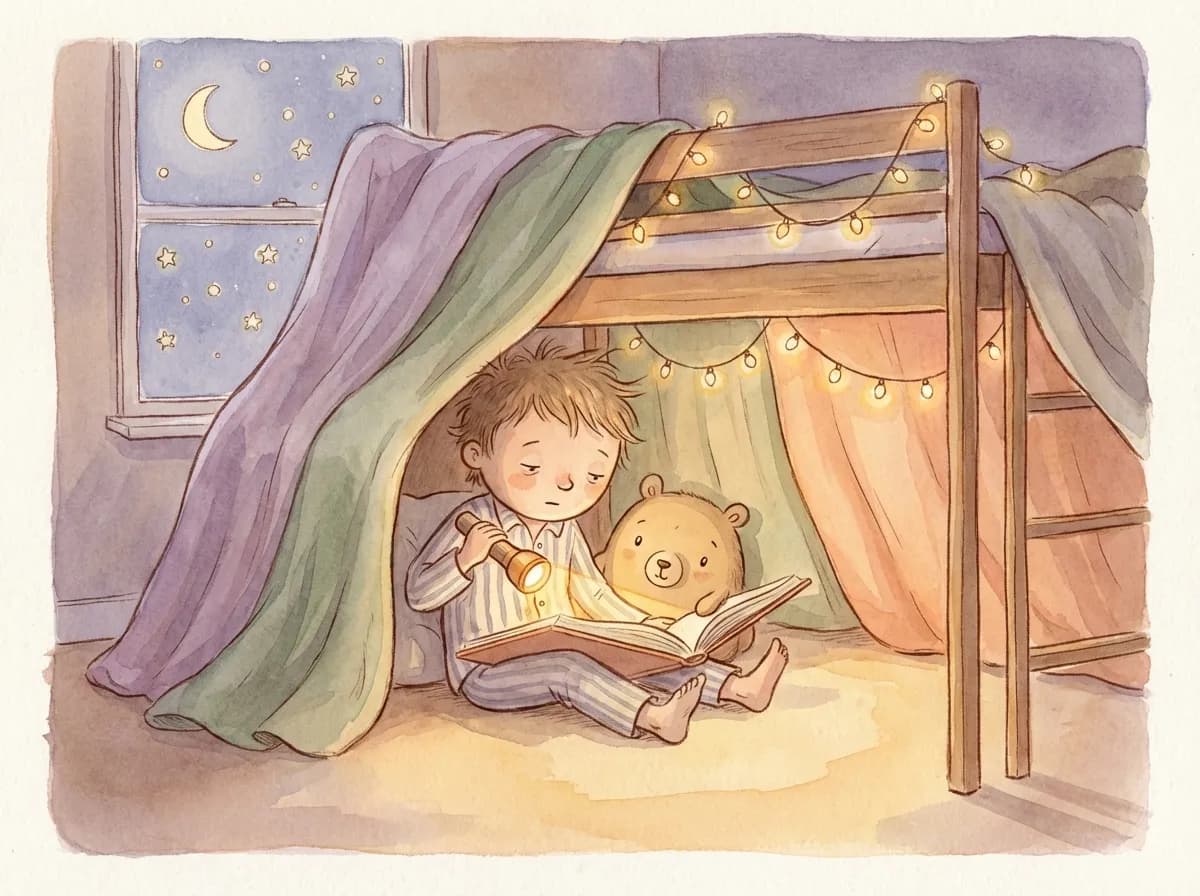
At six, seven, and eight, your child is doing everything for the first time independently: reading alone, handling friendships without you, managing a classroom. By evening, they have spent all day being brave. Bedtime is often when the bravery runs out and the need for parental connection resurfaces.
This is not going backward. It is refueling. Mindell and colleagues found that the more consistent a child's bedtime routine, the better their sleep across the board—children with steady nightly routines fell asleep faster, slept longer, and woke up less often (Mindell et al., 2015, Sleep, DOI: 10.5665/sleep.4662). A brief, consistent bedtime connection with a parent—even just ten minutes of reading together or quiet conversation—can be a powerful part of that routine.
The key is calibrating the connection to your child's growing independence. A six-year-old might still want you to read aloud. An eight-year-old might prefer reading side by side, each in their own book, or having a quiet conversation about the day. The format matters less than the presence. Ten minutes of undivided attention at bedtime pays dividends in sleep quality that no sleep hygiene tip can match.
Frequently Asked Questions
Common questions parents ask.
Sleep Challenges at Other Ages
Sleep challenges evolve as your child grows. Find guidance for every stage.
A Story That Helps Your Child Wind Down
Create a personalized bedtime story for your school-age child—featuring their name, their world, and gentle lessons about getting through nighttime with courage. Designed to replace screens with connection.
Start Your Free Story