Building a Bedtime Routine That Actually Works
You've read all the advice. Bath, book, bed. But what happens when your child is still wide-eyed at 9:30, negotiating for one more glass of water? The truth is, a bedtime routine only works when it's built around how your child's brain actually transitions to sleep—not around what sounds good on paper.
What You'll Learn
- Bedtime routines work because your child's brain learns to start winding down the moment the routine begins—before they even get into bed.
- A consistent 30-minute wind-down sequence—transition signal, physical care, quiet connection, story, goodnight ritual—is more effective than any single sleep strategy.
- The consistency of your routine matters more than its specific steps. Your child’s brain craves the pattern, not the particulars.
- Reading a calming story in the final 10 minutes is the bridge between daytime energy and drowsiness—your child’s brain shifts from active thinking to quiet listening.
- If a consistent routine still isn’t working after several weeks, something deeper like anxiety or a breathing issue during sleep may need a professional look.
Why Do Bedtime Routines Work? The Neuroscience
Bedtime routines work because of how the brain learns patterns: when your child encounters the same calming sequence at the same time each night, their brain starts sending sleep signals before they even get into bed. A consistent 30-minute wind-down routine literally trains the brain to prepare for sleep automatically.
A bedtime routine is not just about habit. It is about how your child's brain works. When your child's brain encounters the same calming sequence each night, it starts releasing sleep signals on cue. That is why doing the same routine at the same time each night actually trains the brain to start getting ready for sleep before your child even gets into bed.
A landmark study by Mindell and colleagues found that a consistent nightly bedtime routine significantly improved sleep outcomes in young children, including reduced sleep onset latency and fewer night wakings (Mindell et al., 2009, DOI: 10.1093/sleep/32.5.599). Lower stress hormones mean less of that wired-but-tired feeling, fewer bedtime battles, and faster sleep.
Further research has demonstrated that the consistency of a routine matters more than its specific components. Whether your routine includes a bath, a song, or a puzzle doesn't matter nearly as much as whether the sequence is the same each night. The brain craves the pattern, not the particulars. The National Sleep Foundation recommends a consistent bedtime routine as one of the most effective strategies for improving pediatric sleep quality.
What Does a 30-Minute Wind-Down Routine Look Like?
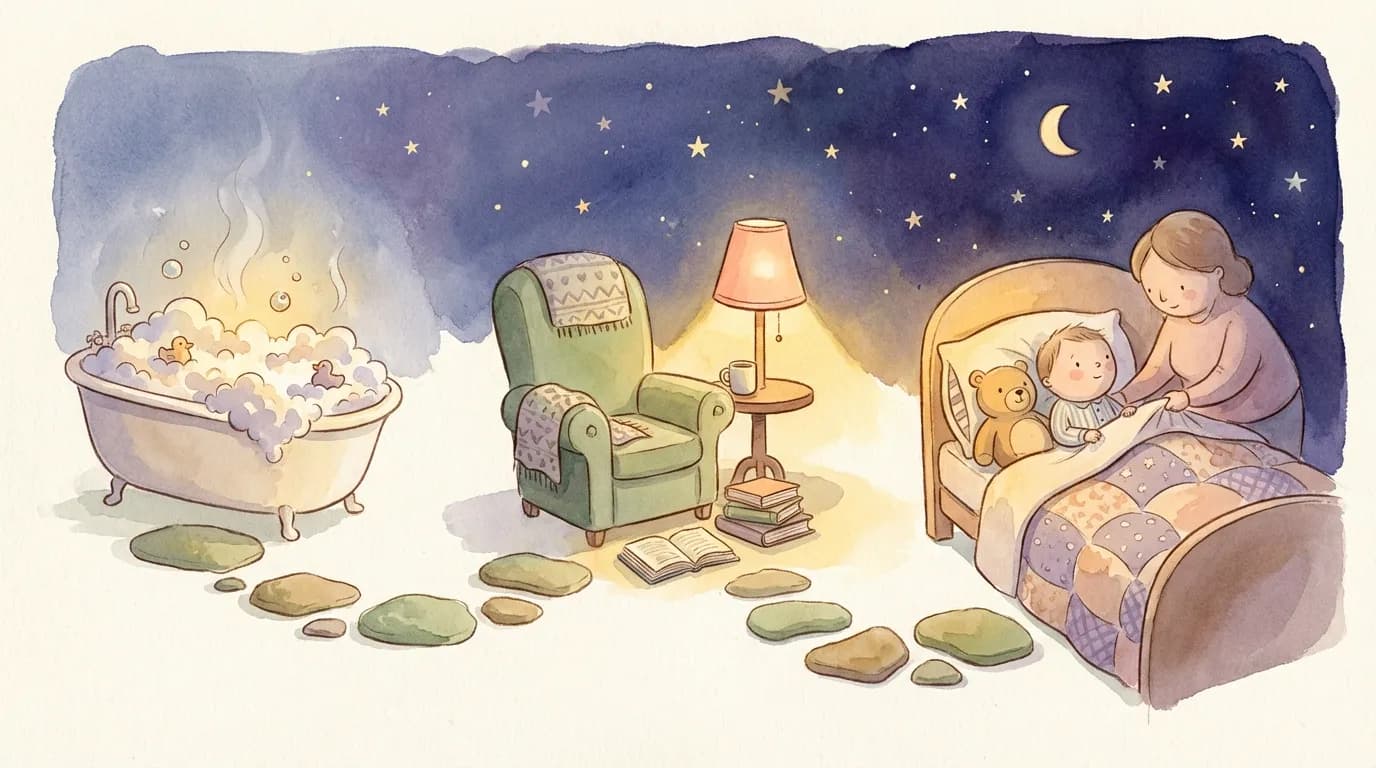
This template is a starting point, not a rigid prescription. Adjust the times and activities to fit your family's life. The important thing is the arc: from active to calm, from stimulated to settled.
The Transition Signal
Give a clear, consistent signal that the bedtime routine is starting. This might be turning off screens, dimming lights, or a verbal cue like “It's wind-down time.” The signal matters because it gives the brain a chance to start shifting gears. Avoid screens during this entire period—blue light suppresses melatonin production.
Physical Care
Bath or wash-up, brushing teeth, changing into pajamas. These physical actions are body-level signals that sleep is coming. Warm water is especially helpful—after the bath, your child's body cools down, which mirrors the natural temperature drop that happens right before sleep.
Quiet Connection
A brief, calm activity that connects you with your child. This might be a few minutes of quiet play, a short conversation about the day, or a simple gratitude practice (“What was your favorite part of today?”). The goal is warm connection without stimulation.
The Story Slot
This is the most powerful 10 minutes of the routine. Reading a story in a calm, steady voice creates a bridge between the alertness of the day and the quiet of sleep. The child's brain shifts from active processing to receptive listening, mirroring the transition from wakefulness to drowsiness. Personalized bedtime stories make this time even more effective by weaving in calming imagery and emotional resolution.
The Goodnight Ritual
A consistent final moment: a goodnight phrase, a kiss, a tucking-in of a stuffed animal. This is the bookend that signals the routine is complete and sleep can begin. Keep it brief, warm, and the same every night.
How Should You Adjust Bedtime Routines by Age?
The same routine won't work for a three-year-old and a ten-year-old. Here's how to adapt the framework for different developmental stages.
Toddlers (Ages 2–4): Sensory and Simple
Keep the routine short, sensory-rich, and highly predictable. Toddlers thrive on repetition—the same song, the same story, the same sequence. Use physical cues (warm bath, soft pajamas, a specific blanket) to signal sleep. Offer limited choices to give a sense of control without overwhelm: “Do you want the blue pajamas or the green pajamas?” Mindell and colleagues found that a three-step nightly routine (bath, massage, quiet activity) reduced night wakings and improved maternal mood within just two weeks in infants and toddlers (Mindell et al., 2006, DOI: 10.1093/sleep/29.1.85).
School-Age Children (Ages 5–8): Choice and Connection
At this age, children benefit from having some ownership over the routine. Let them choose which book to read, which stuffed animal sleeps with them, or which quiet activity fills the connection slot. Include a brief check-in about their day—not a deep conversation, but enough to let them know you're available. Children who feel emotionally seen before bed fall asleep more easily because they're not lying awake processing unresolved feelings.
Tweens (Ages 9–12): Autonomy and Wind-Down
Older children need more autonomy but still benefit enormously from structure. Let them manage more of the routine independently while keeping the anchor points—screen-off time, story or reading time, lights-out time. This age group is especially vulnerable to screen-related sleep disruption. The American Academy of Pediatrics recommends removing screens for at least 30–60 minutes before bed, and Hale and Guan found a consistent association between screen time and reduced sleep duration in children and adolescents (Hale & Guan, 2015, DOI: 10.1016/j.smrv.2014.07.007). A shared reading or story moment, even at this age, maintains connection and signals transition.
What Are the Most Common Bedtime Routine Saboteurs?
Even great routines can be undermined by a few common culprits. Knowing what to watch for can save you weeks of frustration.
Screens
The light from tablets, phones, and TVs interferes with the brain's sleep signals and keeps your child in alert mode. Even “calm” screen content fires up the brain differently than a book or quiet play. The American Academy of Pediatrics recommends no screens for at least 30–60 minutes before bed.
Sugar and Stimulants
A sugary snack or drink close to bedtime can cause a blood sugar spike that makes falling asleep harder. Watch for hidden sources: juice boxes, flavored yogurts, and even some children's medications contain more sugar than you would expect. If your child needs an evening snack, go for something with whole grains and protein instead.
Inconsistency
The biggest routine saboteur is inconsistency. When the routine changes night to night, your child's brain cannot learn the pattern. This does not mean you need military precision—life happens. But the core sequence should be recognizably the same most nights of the week.
Overstimulating Activities
Roughhousing, competitive games, exciting videos, and even heated sibling arguments within an hour of bedtime flood your child's body with stress hormones and adrenaline. Save the pillow fights for after school and keep the pre-bed hour calm and connected.
Why Is the Story Slot the Most Powerful 10 Minutes?
Of everything in the bedtime routine, the story slot is the one element that does double duty. It is both a sleep tool and an emotional tool. While your child listens to a story, their breathing slows, their muscles relax, and their brain shifts from alert and active to calm and drowsy—the state that leads directly into sleep.
But the story is doing more than lulling them to sleep. It's also providing a safe space for emotional processing. A story about a character who handled a difficult day, who faced a fear, or who felt lonely and found connection—these narratives don't just entertain. They give your child a framework for understanding their own inner life.
This is why the right story at bedtime matters so much. A story that mirrors your child's real-world challenges—read in a warm voice, in a safe space—becomes the emotional debrief of the day. It's the conversation your child might not be ready to have directly, delivered through the safe distance of a character's journey.
When Are Bedtime Routines Not Enough?
Sometimes, even the best bedtime routine isn't enough. If your child has a consistent, calming routine and is still regularly struggling to fall asleep, waking frequently, or showing significant distress at bedtime, it may be worth exploring whether something deeper is at play.
Signs that may warrant a conversation with your pediatrician include: persistent difficulty falling asleep despite a consistent routine (more than 30–45 minutes most nights), frequent nighttime awakenings with difficulty returning to sleep, significant daytime sleepiness or behavioral changes, snoring or labored breathing during sleep, or bedtime anxiety that seems disproportionate to the situation.
Underlying issues like anxiety, breathing problems during sleep, restless legs, or sensory sensitivities can all disrupt sleep in ways that routine alone cannot fix. If your child is also dealing with nighttime fears, addressing those fears alongside the routine can make a significant difference. There is no shame in seeking professional support—it's one of the most caring things a parent can do.
Frequently Asked Questions
Common questions parents ask.
Make Bedtime the Best Part of the Day
Create a personalized bedtime story that becomes the anchor of your child's nightly routine—a story they ask for, set in their own world.
Start Your Free Story