Social Skills in Children Ages 3-5: Building the First Friendships
Your preschooler is not just learning their colors and counting to ten. They are learning something far more complex: how to exist alongside other small humans who also want the red crayon. These early social experiences lay the foundation for every friendship, collaboration, and relationship that follows.
What You'll Learn
- Between ages 3 and 5, children transition from parallel play (side by side) to cooperative play (face to face) — a major social milestone that unfolds at each child's own pace.
- Use timers for turn-taking and let your child set aside a few treasured toys before playdates, which makes sharing the rest feel less threatening.
- Your child watches your social behavior closely through social referencing, so modeling warmth with others is one of the most powerful things you can do.
- Coach through conflicts in real time by narrating what happened, validating feelings, and offering choices rather than punishing after the fact.
- Preschoolers absorb social lessons through stories and play far more effectively than through direct instruction like "be kind" or "share nicely."
How Do Social Skills Develop in Children Ages 3–5?
Between ages 3 and 5, children transition from parallel play (side by side) to cooperative play (face to face)—a major social milestone. Sharing, turn-taking, and reading social cues are genuinely difficult at this age because the brain regions governing empathy and impulse control are still developing. Most social conflicts at this stage are normal developmental growing pains.
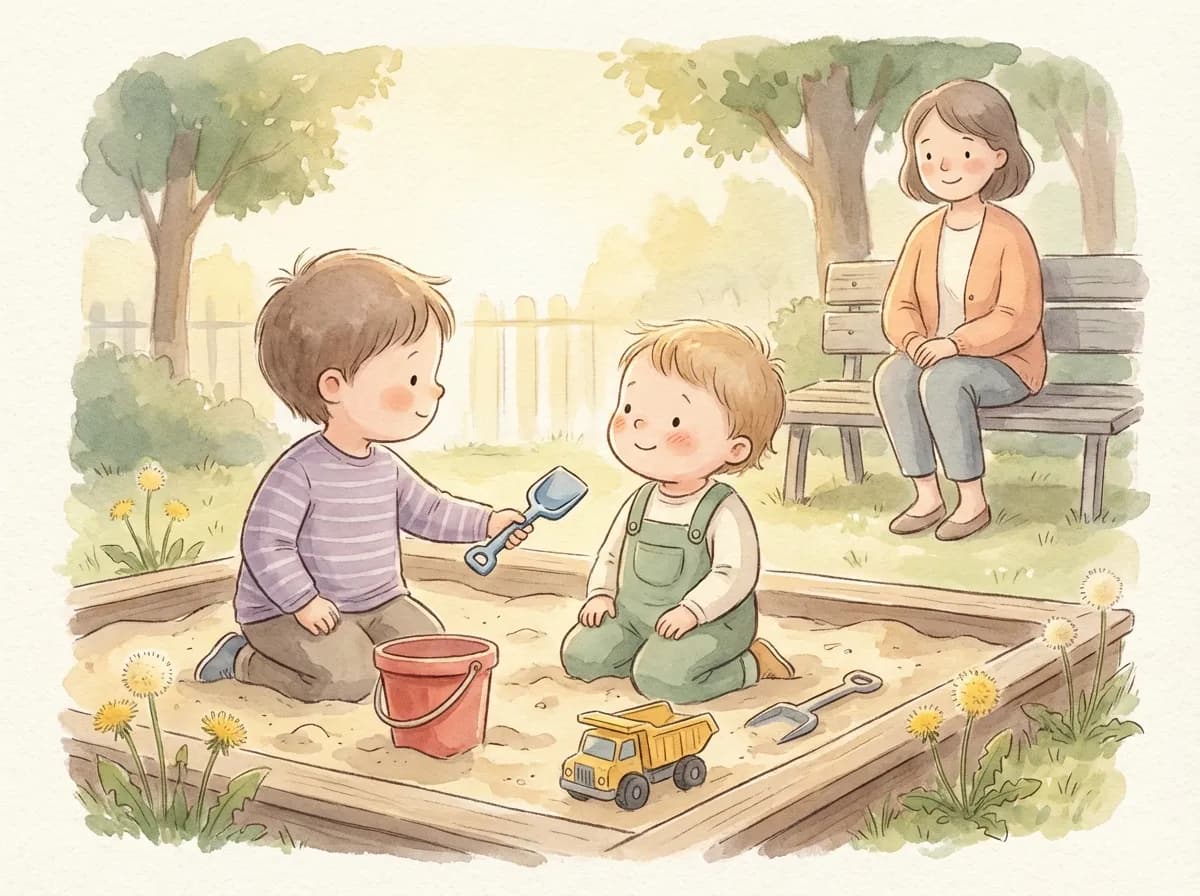
Between ages two and five, your child goes through one of the biggest social shifts of childhood: moving from playing next to other kids to playing with them. At first, your child may sit beside another child at the sandbox, each digging their own hole, barely acknowledging the other. This is not antisocial. This is exactly where they should be.
Playing side by side is how young children get comfortable being around other kids. They are watching, absorbing the unwritten rules, and building the emotional steadiness they will need to eventually team up with someone else. Research by Kenneth Rubin and colleagues has shown that this progression from solo play to side-by-side play to playing together is a reliable developmental sequence, and children who are given space to move through it at their own pace develop stronger social skills over time (Rubin et al., 2007, Handbook of Child Psychology: Social, Emotional, and Personality Development, DOI: 10.1002/9780470147658.chpsy0310).
Sometime around age three or four, you will begin to notice a shift. Your child starts handing blocks to the child beside them. They narrate what the other child is doing. They invent a shared game. This is the beginning of cooperative play, and it is a milestone worth celebrating—even when it ends in a disagreement over who gets to be the dragon.
The Hard Work of Sharing and Turn-Taking
To an adult, sharing a toy seems simple. To a three-year-old, it can feel like losing something precious with no guarantee of getting it back. This is not selfishness. Your child is still figuring out that a toy lent is not a toy lost -- and that takes time.
Denham and colleagues found that preschoolers who are better at sharing and cooperating do better socially and academically through elementary school. But here is the key: these skills develop through practice and gentle guidance, not through commands to “share nicely” (Denham et al., 2003, Child Development, 74(1), 238–256, DOI: 10.1111/1467-8624.00533).
What actually helps
- Use timers for turn-taking. “You can use it for two minutes, then it is Max's turn.” A visible timer makes the abstract concrete.
- Allow some special objects to be off-limits. Before a playdate, let your child put away one or two treasured toys. This gives them agency and makes sharing the rest feel less threatening.
- Narrate the social exchange. “Look, when you gave Emma the blue block, she smiled. That made her happy.” You are teaching your child to read cause and effect in social interactions.
- Model sharing yourself. “I am going to share my snack with you. Would you like some?” Children learn far more from watching than from being told.
Social Referencing: Your Child Is Watching You
Long before your preschooler can put social rules into words, they are learning them by watching you. Researchers call this social referencing -- your child looks to you to figure out how to react to new people and new situations.
When you arrive at a new playground and your child glances back at you, they are not just checking that you are there. They are reading your face. If you look relaxed and encouraging, they are more likely to approach other children. If you look anxious or tense, they will pick up on that signal and hold back.
This means that one of the most powerful things you can do for your preschooler's social growth is to model social warmth yourself. Greet other parents. Chat with the cashier at the grocery store. Let your child see that interacting with others is safe, pleasant, and normal. Research consistently shows that children whose parents are warm and social with others are more likely to build healthy friendships themselves.
Separating from You to Find Their People
For many preschoolers, the biggest social hurdle is not interacting with other kids—it is being willing to leave you long enough to try. Separation difficulty is one of the most common concerns parents bring up, and it is almost always a sign of healthy attachment, not a social problem.
Your child clings at preschool drop-off not because something is wrong with their social wiring, but because you are their secure base. The world beyond you is still being mapped. With patience, predictable routines, and gentle encouragement, most children build the confidence to venture out.
Strategies that work
- Create a brief, consistent goodbye ritual (same words, same hug, same wave)
- Arrive early so your child can settle before the group energy ramps up
- Send a comfort object from home as a transitional anchor
- Talk about who they will see and what they will do before you arrive
What to avoid
- Sneaking away without saying goodbye (breaks trust)
- Prolonged, emotional goodbyes (amplifies distress)
- Returning when they cry (teaches that crying brings you back)
- Comparing them to other children who separate easily
When Small People Have Big Conflicts
Preschool social life is not gentle. There will be toy-snatching, pushing, biting, and declarations that “you are not my friend anymore.” As alarming as these moments are, they are not signs of a troubled child. They are signs of a child learning conflict resolution with a brain that has not yet developed impulse control.
The part of the brain that handles impulse control, empathy, and planning does not fully develop until the mid-twenties. In preschoolers, it is barely switched on. This means that your child genuinely cannot yet “use their words” in the heat of the moment—but they can learn with practice and support.
Bierman's research found that children who get coaching during conflicts—rather than punishment after them—develop stronger problem-solving skills and are less likely to be left out by other kids in elementary school (Bierman, 2004, Peer Rejection: Developmental Processes and Intervention Strategies, Guilford Press).
Coaching through conflict in real time
Step 1: Get close. Move to your child's level physically. Your calm presence is the first intervention.
Step 2: Narrate what happened. “You both wanted the truck. That is hard.” No blame, just observation.
Step 3: Validate the feeling. “You are frustrated because you were using it first.”
Step 4: Offer a solution they can choose. “You could take turns, or you could find another truck to play with. What do you think?”
How Stories Teach What Lectures Cannot
At three, four, and five years old, children process the social world through narrative and play far more effectively than through direct instruction. You can tell a preschooler to “be kind” a hundred times, but a story about a character who shares their favorite blanket with a scared new friend teaches kindness in a way that lands differently.
When the character in the story shares your child's name, their favorite stuffed animal, and their specific social challenge, the story becomes a mirror. Your child does not just hear about a character who learned to play with others—they see themselves doing it. That is the power of personalized storytelling, and research confirms that children who are better at understanding and managing their own feelings—and reading others'—do better socially with peers over time (Denham et al., 2003, Child Development, 74(1), 238–256).
Frequently Asked Questions
Common questions parents ask.
A Story About Making Their First Friend
Create a personalized story where your child's favorite toy helps them figure out sharing, turn-taking, and the joy of finding a friend. Tailored to their world, designed for bedtime.
Start Your Free Story