Anxiety in Tweens Ages 9\u201312: When Worry Gets Sophisticated
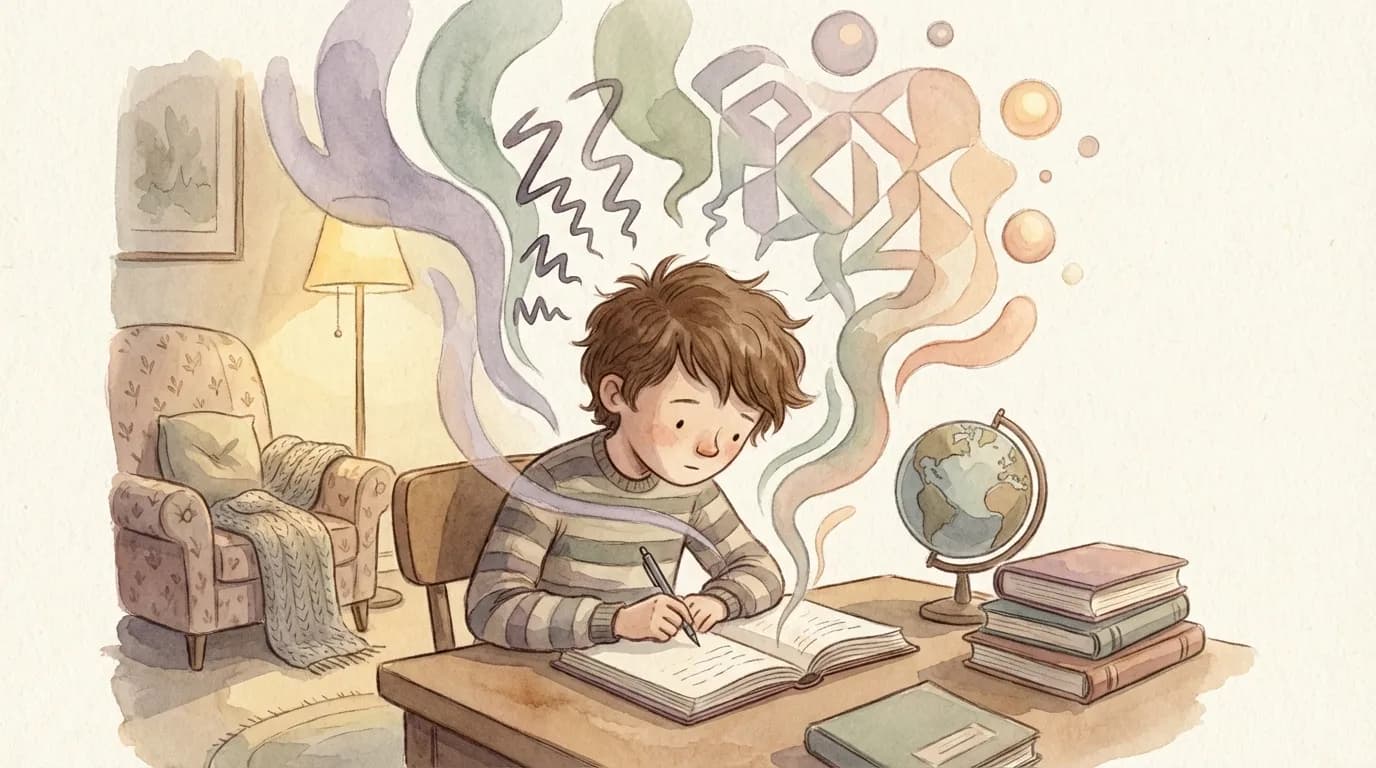
Your tween\u2019s brain is doing something extraordinary: developing the capacity for abstract thought, future planning, and complex social reasoning. This cognitive leap is essential for growing up. It is also the reason their anxiety has transformed from simple fears into something far more intricate\u2014worry that chains one thought to another, spiraling from a failed quiz to \u201cI will never get into college\u201d in under a minute.
What You'll Learn
- Tween anxiety becomes more complex because the part of the brain that generates worries outpaces the part that manages them.
- Validate before you strategize—tweens shut down when they feel lectured, but open up when they feel heard.
- Teach your tween to recognize "thinking traps" like catastrophizing and mind-reading so the thought pattern loses its power.
- Body-based strategies like deep breathing and muscle relaxation work faster than cognitive techniques during acute anxiety.
- Personalized stories act as narrative mirrors that validate a tween's experience and model resilience without feeling like a lecture.
What Brain Changes Drive Anxiety in Children Ages 9–12?
Between ages 9 and 12, your child's brain makes a huge leap. They can now think about thinking, imagine hypothetical futures, and understand that other people are judging them. This is amazing for learning—and terrible for anxiety. It transforms simple childhood fears into worry chains—one bad thought cascading into an entire catastrophic story.
Between ages nine and twelve, your child's brain is doing something extraordinary: developing the ability to think about their own thinking, imagine what could go wrong in the future, and understand that other people have opinions about them. This is a massive leap in how their mind works—and it changes the nature of worry completely.
A five-year-old fears the monster under the bed. A nine-year-old fears failing the math test. An eleven-year-old fears failing the math test, which means they are stupid, which means their parents will be disappointed, which means they will never succeed, which means something is fundamentally wrong with them. This cascading worry—where one bad thought leads to the next and each one gets worse—is not a character flaw. It is a normal brain doing what newly developing abstract thinking does when paired with an anxious temperament.
Here is the key: the part of your tween's brain that generates worries is developing faster than the part that manages them. Think of it as the gas pedal getting stronger while the brakes are still catching up. Researchers call this an “imbalance”—a period where emotional intensity outpaces the ability to regulate it (Casey, Getz & Galván, 2008, Developmental Review, DOI: 10.1016/j.dr.2007.08.003). Understanding this helps: your tween is not being dramatic. Their worry-generating machinery is simply running ahead of their worry-managing machinery.
How Tween Anxiety Shows Up
Tween anxiety is harder to spot than younger children's anxiety because tweens have learned to hide it. They may not cling or cry. Instead, they withdraw, get irritable, or develop strategies to avoid the things that frighten them so subtly that you do not realize avoidance is happening.
Catastrophic Thinking Chains
This is the hallmark of tween anxiety. One worry leads to another, each step escalating in severity. “What if I say something weird at the party? Then everyone will think I am strange. Then no one will want to be my friend. Then I will be alone forever.” These thought chains feel completely logical to your tween—each step seems to follow inevitably from the last. They do not yet have the cognitive flexibility to interrupt the chain or question its assumptions.
Social Anxiety and Self-Consciousness
The tween years bring an intense awareness of being watched and judged. Your child may become painfully self-conscious about how they look, what they say, or how other kids see them. They might avoid raising their hand in class, turn down party invitations, or spend an hour agonizing over a single text message. Studies show that social anxiety peaks during late childhood and early adolescence, with up to 10% of tweens meeting criteria for social anxiety disorder (Beesdo et al., 2009, Psychiatric Clinics of North America, DOI: 10.1016/j.psc.2009.06.002). Behind the avoidance is usually a single fear: being judged and found lacking.
Test Anxiety and Performance Pressure
Your child studied for hours. They know the material. But when the test lands on their desk, their mind goes blank. Their stomach hurts. They cannot remember anything they reviewed the night before. This is test anxiety, and it is maddingly unfair: the stress hormones flooding their brain shut down exactly the functions they need—memory, recall, flexible thinking. The most prepared kids can score far below what they actually know (Putwain & Daly, 2013, Learning and Individual Differences, DOI: 10.1016/j.lindif.2013.07.010).
Sleep Disruption From Racing Thoughts
Ask your tween what happens at bedtime and you will probably hear: “My brain will not shut off.” The moment the lights go out, every distraction disappears and your child is alone with their thoughts. Worries that were background noise during the busy day become deafening in the quiet dark. They replay conversations, rehearse tomorrow's problems, and spiral into worst-case scenarios. Then the lost sleep makes the next day's anxiety worse, which makes the next night harder, and the cycle keeps going. For more on this pattern, see our guide on bedtime anxiety in children.
Irritability: Anxiety in Disguise
Here is one that catches many parents off guard: the snapping, the eye-rolling, the meltdown over something tiny. It looks like attitude. But for many tweens, it is actually anxiety wearing a disguise. When your child's nervous system has been on high alert all day, there is nothing left in the tank for patience. They are not choosing to be difficult. They are running on empty.
Teaching Your Tween About “Thinking Traps”
Unlike younger kids, tweens are ready to learn about how their own thinking works. One of the most powerful tools you can give them is the concept of “thinking traps”—common patterns where the brain jumps to conclusions that fuel anxiety. Studies show that kids as young as nine can learn to spot these patterns, and once they do, the anxious thoughts start to lose their grip.
Catastrophizing
Jumping to the worst possible outcome. “I got one question wrong, so I probably failed the whole test, so my grade will drop, so I will not get into a good school.”
Counter: “What is the most likely outcome, not the worst?”
Mind-Reading
Assuming you know what others think. “Everyone at the table was laughing. They were definitely laughing at me.”
Counter: “Is there another explanation for what happened?”
All-or-Nothing
Seeing things in black and white. “If I am not the best at this, I am the worst. If they do not like everything about me, they do not like me at all.”
Counter: “What is between the best and worst case?”
Filtering
Focusing only on negatives while ignoring positives. “The teacher said one thing I could improve. Everything else she said does not matter.”
Counter: “What is the full picture, good and bad?”
The goal is not to argue your tween out of their thoughts. It is to help them notice the pattern. Once they can say “Oh, I am catastrophizing again,” the thought loses some of its power. Name the trap, do not fight the thought.
Strategies That Respect Their Growing Independence
Tweens are in the process of becoming autonomous people. They need to feel that their anxiety management is their own, not something being done to them. The most effective strategies at this age are collaborative, not directive.
Validate before you strategize
Your tween will shut down the moment they feel a lecture coming. Before you offer any strategy, make them feel heard first. “That sounds really stressful. I can see why that would worry you.” You are not agreeing that their worst fear will come true. You are telling them the feeling is real and it makes sense. The SPACE trial showed that when parents focused on validating emotions and reducing accommodation, it worked just as well as therapy for childhood anxiety (Lebowitz et al., 2020, Journal of the American Academy of Child & Adolescent Psychiatry, DOI: 10.1016/j.jaac.2019.02.014).
Cognitive reframing as a skill, not a correction
Once your tween feels heard, you can gently help them examine the thought. The key is framing it as a skill they are building, not proof that they are thinking wrong. Try: “Your brain jumped to the worst case. That makes sense—anxious brains are really good at that. What do you think will actually happen?” You and your tween are on the same team, both facing the worry together. Never you against your tween.
Physical strategies for a racing mind
When anxiety hits hard, trying to think your way out of it does not work -- the stress response has taken over the thinking part of the brain. Body-based techniques work faster: deep belly breathing (four counts in, six counts out), tensing and releasing muscles one group at a time, cold water on the wrists or face, or intense movement like sprinting or jumping jacks. These help the body's calm-down system kick in and bring the thinking brain back online. Practice these together when your tween is calm so they have them ready when panic hits.
Stories as mirrors, not lessons
Your tween will resist a lesson. But a story? A story slips past the defenses. When a character their age faces the same social pressure, the same racing thoughts, the same spiral from one bad moment to “my life is over”—and finds their way through—your tween absorbs the message without feeling talked down to. The character gives them permission to see their own struggles reflected back and imagine a different response. This is why personalized storytelling is still powerful at this age. The landmark CAMS trial found that CBT for childhood anxiety produces lasting improvements that hold up years later (Walkup et al., 2008, New England Journal of Medicine, DOI: 10.1056/NEJMoa0804633).
When Professional Support Is Needed
Here is the good news: tween anxiety responds really well to treatment. Therapy for this age group has some of the strongest success rates in all of psychology, with over 60% of kids improving significantly (Walkup et al., 2008). Talk to a professional if:
- Your tween's social world is getting smaller—they turn down invitations, pull away from friends, or refuse group activities
- Academic performance has dropped noticeably due to test anxiety, avoidance, or inability to concentrate
- Sleep problems last more than two weeks even after you have tried good bedtime routines
- Your tween talks about feeling hopeless, worthless, or persistently sad on top of the anxiety
- The irritability, anger outbursts, or withdrawal keeps getting worse no matter what you try
Your pediatrician is a great place to start. For a detailed walkthrough of finding the right help, see when to seek professional help for your child's anxiety.
Frequently Asked Questions
Common questions parents ask.
A Story That Gets What They Are Going Through
Create a personalized story where a character your tween's age faces the same worries, the same social pressures, and the same racing thoughts—and discovers they can handle it. No lectures. Just a story that understands.
Start Your Free Story